


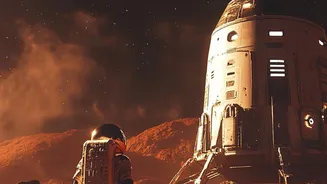
The Moon's Hidden Treasure
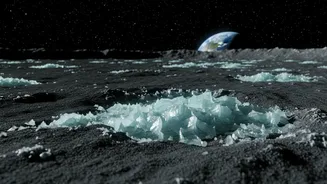
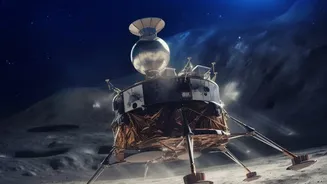
For decades, the Moon was thought to be bone-dry. But a series of missions, including India's Chandrayaan-1 and Chandrayaan-2, have confirmed the presence of a priceless resource: water ice. This isn't found in flowing rivers, but locked away as frost
and sub-surface ice within Permanently Shadowed Regions (PSRs). These are deep craters near the lunar poles where the sun's rays have not reached for billions of years. The value of this ice cannot be overstated. It can provide drinking water and be split into breathable oxygen for astronauts. More importantly, its components—hydrogen and oxygen—are the primary ingredients in powerful rocket propellant.
The Challenge of Eternal Darkness
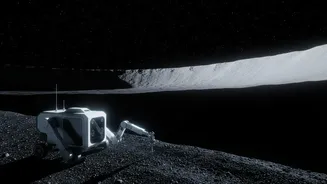
Extracting this resource is an immense engineering feat. The PSRs are some of the coldest known places in the solar system, with temperatures plunging to below -240°C. Machinery designed for this environment must withstand extreme cold that can make metals brittle. Furthermore, these craters are perpetually dark, meaning solar-powered rovers are not an option. Any mining operation would need a consistent power source, likely from a nearby small nuclear reactor or power beamed from a sunlit ridge several kilometers away. The terrain itself is often rugged and difficult to navigate, presenting a major challenge for robotic systems.
ISRO’s Blueprint for Extraction
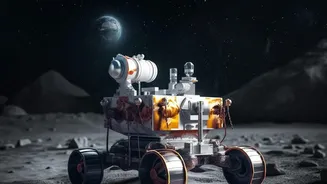
ISRO's strategy, informed by data from its Chandrayaan missions, focuses on robotic exploration and in-situ resource utilization (ISRU), which means using local materials. The LUPEX mission, a joint venture between ISRO and Japan's JAXA, is a key next step. The conceptual plan involves a rover equipped with specialized tools. This rover would navigate into a PSR and use a drill or excavator to dig up the icy regolith (the Moon's soil). This soil would then be heated inside a contained processing unit. Because of the Moon's near-vacuum, the ice won't melt into liquid; instead, it will sublimate directly into water vapour. This vapour can then be captured and collected.
From Ice to Rocket Fuel
Once the water is collected, either as vapour or re-condensed liquid, the magic of chemistry begins. The process is called electrolysis. By passing an electric current through the water (H₂O), it can be split into its constituent elements: hydrogen and oxygen. These gases would be captured and stored in a super-chilled, liquefied state. Liquid hydrogen and liquid oxygen are a highly efficient, powerful rocket propellant combination—the same type used by some of Earth's most powerful rockets. The ability to produce this fuel on the Moon would be revolutionary.
A Gas Station in the Sky
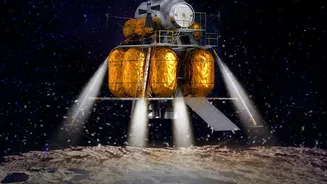
Creating rocket fuel on the Moon fundamentally changes the economics of space exploration. Currently, every kilogram of fuel needed for a return trip or a journey further into the solar system must be launched from Earth, which is incredibly expensive due to our planet's strong gravity. By turning the Moon into a celestial refueling station, future missions could launch from Earth with less fuel, making them lighter and cheaper. A spacecraft could then stop at the Moon to top up its tanks before journeying onward to Mars or beyond. This makes the Moon not just a destination, but a critical stepping stone for humanity's expansion into the solar system.