
A Decades-Old Cosmic Mystery
The story begins with a cold case buried in the archives of the Hubble Space Telescope. Data from a 1999 observation of a white dwarf star named HS 0209+0832, located about 270 light-years away, contained around 100 chemical signatures that astronomers
at the time couldn't identify. For over two decades, this stellar puzzle remained unsolved. Recently, a team of astronomers, led by Jamie Williams from the University of Warwick, decided to revisit the mystery with the aid of updated chemical databases. What they found was astonishing: a chemical fingerprint that points not to a surviving planet from the star's youth, but to a 'phoenix planet' born after the star's demise.
What Is a White Dwarf?
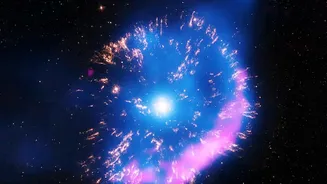
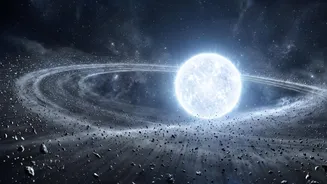
To understand the significance of this discovery, it is crucial to know what a white dwarf is. Over 95% of all stars, including our own Sun, will eventually end their lives this way. When a star of a certain mass runs out of its nuclear fuel, it can no longer support its own weight. It expands into a massive red giant, shedding its outer layers into space, before the hot, dense core collapses into an Earth-sized object of incredible density. This remnant is a white dwarf—the glowing, cooling ember of a once-mighty star. For a long time, this was seen as the final, quiet chapter in a star's story. This new discovery, however, suggests an exciting epilogue is possible.
The Telltale Chemical Signature
The key to unlocking the mystery of HS 0209+0832 was its bizarre atmospheric composition. White dwarfs are often 'polluted' by metals from asteroids or planets that fall into them, but the elements found here were unique. The team detected high levels of zinc and copper, and most notably, the element niobium at levels over 1,000 times higher than in our Sun. This was a major clue. Niobium is a heavy element that isn't created during a star's normal life but is forged 'in the exotic conditions that briefly emerge inside dying stars,' explained Nicholas Stone, a researcher on the team. Finding it meant that the material falling onto the white dwarf was not from an old, first-generation planet, but was made from the star's own ashes.
Building a Second-Generation Planet
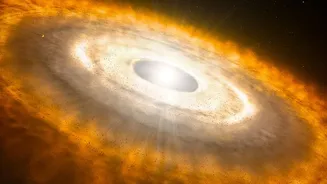
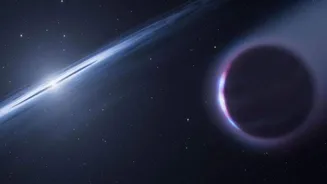
This leads to a remarkable hypothesis: a second-generation planet. The theory is that as the original star died and shed its outer layers, this material—rich in newly created elements like niobium—didn't all disperse. Instead, some of it may have formed a rotating disk of gas and dust around the new white dwarf. From this cosmic debris field, a new giant planet, estimated to be about the size of Jupiter, could have formed. Further evidence from NASA's TESS satellite supports this, having detected a repeating dimming of the star's light every 4.4 days. This is consistent with a large planet orbiting extremely close to the white dwarf, causing its atmosphere to be slowly boiled away and siphoned onto the star—which is why astronomers can detect its unusual elements.
A Glimpse Into Our Own Future?
While this is not the first planet found around a white dwarf, it is the first strong candidate for one that formed after the star's death. 'It's a bit like finding a planet that has risen from the ashes of the very star it once orbited,' said lead author Jamie Williams. The discovery is thrilling because it implies that planetary systems can be reborn. Since white dwarfs are so common, it raises the possibility that countless other second-generation worlds are waiting to be found. It also offers a potential glimpse into the very distant future of our own solar system. As Professor Boris Gänsicke of Warwick notes, 'This system has given birth to a new world using the foundations of the old one.'