




Meet the Roman Space Telescope
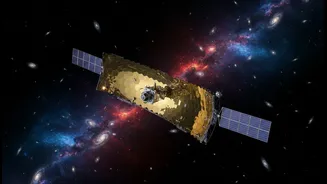
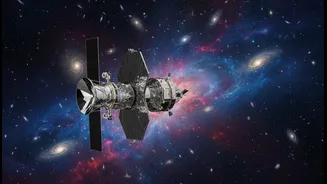
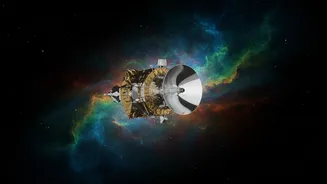
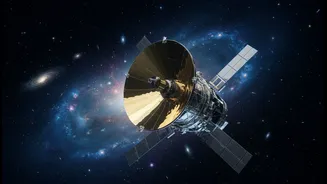
Scheduled to launch around August 2026, the Nancy Grace Roman Space Telescope is a NASA observatory designed to unravel cosmic mysteries on a grand scale. Named after NASA's first Chief of Astronomy, Nancy Grace Roman, it boasts a 2.4-meter primary mirror,
the same size as Hubble's. However, its power lies not in being a Hubble duplicate, but in its revolutionary Wide Field Instrument. This 300.8-megapixel camera gives Roman a field of view at least 100 times larger than that of Hubble or the James Webb Space Telescope (JWST). Imagine trying to survey a massive crowd; while Hubble and JWST meticulously study individual faces, Roman will capture the entire crowd in a single, high-resolution snapshot. This makes it a survey powerhouse, built to map vast stretches of the universe with unprecedented speed and efficiency.
A New Lens on Dark Matter
One of Roman’s primary missions is to shed light on the darkest corners of the universe: dark matter and dark energy. These mysterious components make up about 95% of the cosmos, yet remain largely invisible and unknown. Roman will tackle this by conducting enormous galaxy surveys. It will use a technique called gravitational lensing, where the gravity of a massive foreground object, like a galaxy, bends and magnifies the light from a more distant object. By precisely measuring the distorted shapes of hundreds of millions of galaxies, astronomers can create a detailed map of where unseen dark matter is located, revealing its clumping and structure on a massive scale. These vast surveys will provide crucial data to test theories about the nature of dark energy, the force driving the accelerating expansion of the universe.
A Census of New Worlds
Roman is set to become one of history's most prolific planet hunters, expected to discover thousands, or even hundreds of thousands, of new exoplanets. It will employ two main techniques. The first is the transit method, watching for the tiny dip in a star's light as a planet passes in front of it. But its most unique contribution will come from gravitational microlensing. This method can detect planets far from their stars, rogue planets that don't orbit any star, and even worlds with masses as small as Mars. Microlensing occurs when one star passes in front of another, and its gravity briefly magnifies the background star's light. A planet orbiting the foreground star will cause a characteristic blip in that signal, revealing its presence. This will give us a statistical census of planets across a huge portion of our galaxy.
Knowing Its Place in the Cosmos
For all its power, Roman is not designed to do everything. The headline is correct: it has limits. It won't see as far back in time or with the same extreme infrared sensitivity as the James Webb Space Telescope. Its strength is its breadth, not its depth compared to JWST. Roman is a survey telescope, designed to be a cosmic cartographer. It will identify countless fascinating targets—rare galaxies, unusual star systems, and intriguing exoplanets. Other telescopes, like the more narrowly focused JWST and Hubble, can then perform deep, detailed follow-up observations. Think of it as a team effort: Roman finds the needle in the haystack, and Webb puts it under the microscope. This division of labor is a strength, allowing astronomers to get a complete picture of the universe by combining Roman's wide-angle panoramas with the detailed zoom of its companions.