


More Than Meets the Eye
Our eyes can only see a narrow slice of light called the visible spectrum. But light comes in many other forms, from low-energy radio waves and infrared to high-energy ultraviolet, X-rays, and gamma rays. Each type of light, or wavelength, is produced
by different physical processes and can only be seen with specialized telescopes. Some of these telescopes must be in space because Earth's atmosphere blocks out high-energy radiation like X-rays. By combining observations from these different bands, astronomers build a complete picture of cosmic objects, revealing secrets that would otherwise remain invisible. This technique, called multi-wavelength astronomy, is like having a set of cosmic keys that unlock different parts of the universe's story.
A Cosmic Case Study: Centaurus A
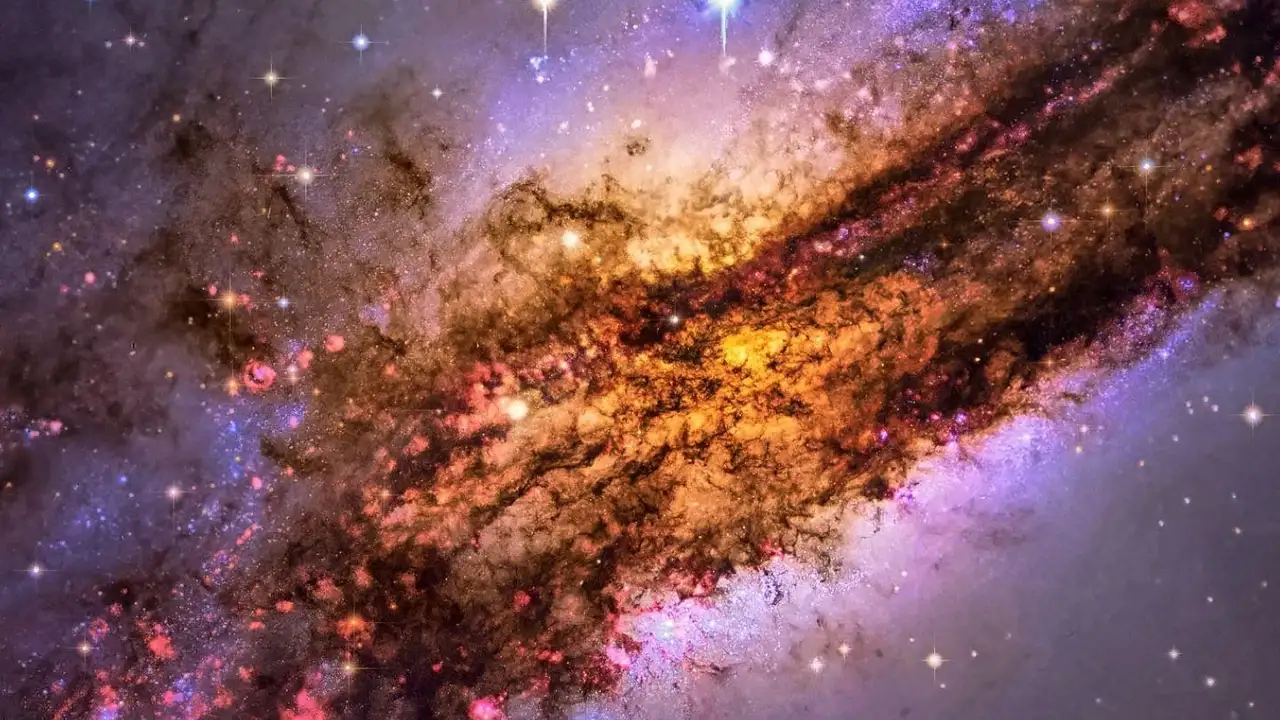
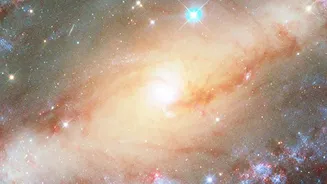
One of the most fascinating subjects for multi-wavelength astronomy is Centaurus A. Located about 12 million light-years away, it's the closest radio galaxy to Earth. To the naked eye (in the Southern Hemisphere) or through a small telescope, it appears as a bright galaxy slashed by a dramatic dark lane of dust. This unusual appearance is the result of a cosmic collision, where a large elliptical galaxy merged with a smaller spiral galaxy hundreds of millions of years ago. While the visible-light view is stunning, it only hints at the violent and complex processes unfolding within. To truly understand Centaurus A, we need to look at it through different eyes.
The X-Ray View: A High-Energy Monster
When astronomers point X-ray telescopes like NASA's Chandra X-ray Observatory at Centaurus A, a completely different portrait emerges. The serene-looking galaxy is revealed to be hiding a monster. X-rays trace extremely hot gas and high-energy events. In Centaurus A, the X-ray view is dominated by a colossal jet of superheated material shooting out from the supermassive black hole at its center. This jet, extending for thousands of light-years, is evidence of the black hole actively feeding on surrounding gas and dust. These observations help astronomers study the most violent and energetic processes in the universe, which are completely invisible to optical telescopes.
The Infrared View: Peeking Through the Dust
That dark, dusty lane that cuts across Centaurus A in visible light is like a roadblock for starlight. But infrared telescopes, like those on the James Webb and Spitzer space telescopes, can peer right through it. Infrared light is great at detecting cooler objects and penetrating dust clouds. In the infrared view of Centaurus A, the dust lane itself begins to glow, revealing its own intricate structure. More importantly, this view uncovers the hidden star-forming regions within the dust, where the galactic merger has triggered the birth of new generations of stars. Without infrared, our understanding of star formation and the true structure of the galaxy's core would be incomplete.
The Radio View: Invisible Structures Made Visible
If the X-ray view reveals a jet, the radio view shows its full, spectacular scale. Radio waves, the lowest-energy light, are produced by different phenomena, including electrons spiraling in magnetic fields—a process known as synchrotron radiation. When radio telescopes like the Very Large Array (VLA) look at Centaurus A, they see two enormous lobes of radio emission that dwarf the visible galaxy, extending millions of light-years into intergalactic space. These lobes are inflated by the jets of particles originating from the central black hole. Viewing the galaxy in radio waves unveils the long-term impact of the black hole on its surroundings, painting a picture of a galaxy that is actively shaping its environment on a massive scale.