




Our Best Bet for Finding Life
For decades, scientists have considered Jupiter's moon Europa one of the most promising places to find life beyond Earth. Though slightly smaller than our own moon, Europa is believed to harbor a global ocean of liquid saltwater beneath its icy shell.
Astonishingly, this hidden ocean may contain about twice as much water as all of Earth's oceans combined. Life as we know it has three essential requirements: liquid water, the right chemical ingredients, and an energy source. Scientists believe Europa may have all three. Its constant orbit around massive Jupiter creates immense gravitational stress, causing the moon's interior to flex and generate heat through a process called tidal heating. This internal warmth likely keeps the ocean liquid and could power hydrothermal vents on the seafloor, similar to those on Earth that support entire ecosystems without sunlight.
Meet the Clipper: A Journey of Billions of Miles
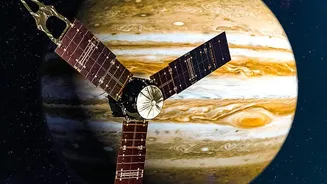
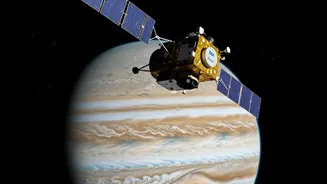
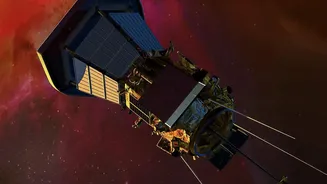
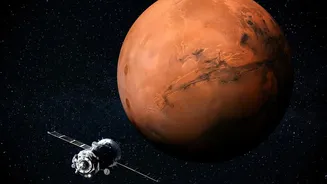
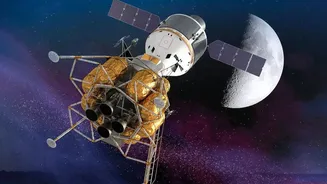
Enter the Europa Clipper, the largest interplanetary spacecraft ever developed by NASA. Launched on October 14, 2024, the probe is currently undertaking a long and complex 1.8-billion-mile journey to the Jovian system. To get there, it’s using gravity assists to build speed, first from Mars in March 2025 and then from Earth in December 2026. The spacecraft is scheduled to arrive at Jupiter and enter its orbit in April 2030. Rather than orbiting the dangerously radioactive Europa directly, the Clipper will loop around Jupiter itself. From this safer vantage point, it will perform nearly 50 close, high-speed flybys of Europa over several years, dipping as low as 16 miles (25 kilometers) above the surface to gather data. The first of these thrilling passes is expected in the spring of 2031.
A Toolkit for Astrobiological Discovery
To peer beneath the ice and sniff for chemical clues, Europa Clipper is equipped with a powerful suite of nine science instruments. These tools work together to paint a comprehensive picture of the moon. An ice-penetrating radar, known as REASON, is designed to measure the thickness of the ice shell and search for subsurface lakes. Spectrometers will analyze the composition of the fractured, icy surface to identify salts and organic molecules that may have bubbled up from the ocean below. Other instruments, like the magnetometer, will confirm the ocean's existence and measure its depth and salinity by studying how Jupiter’s magnetic field interacts with the moon. The probe also carries a dust analyzer and a mass spectrometer, which will act like a nose, sampling any potential plumes of water vapor that might be venting from the ocean into space.
Searching for Habitability, Not Aliens
It's important to clarify that the Europa Clipper mission is not designed to find life itself. Instead, its primary goal is to determine if Europa has the right conditions for life, a concept known as habitability. The mission's three main scientific objectives are to characterize the ice shell and the ocean beneath it, study the moon's composition, and examine its geology for recent activity. By confirming the presence of an ocean, analyzing its chemistry, and identifying potential energy sources, scientists can build a complete profile of this alien world. If the Clipper finds the key ingredients for life—essential elements like carbon, hydrogen, and oxygen, along with an energy gradient and liquid water—it would make Europa the prime target for a future mission designed to actually search for biosignatures, or even life itself.