





Recap: The Heroic Hayabusa2
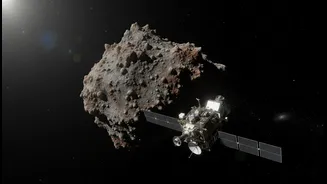
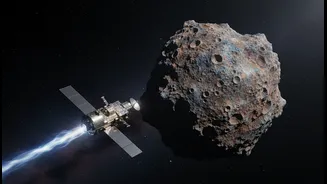
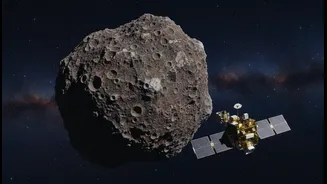
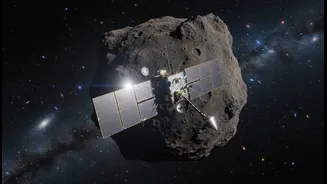
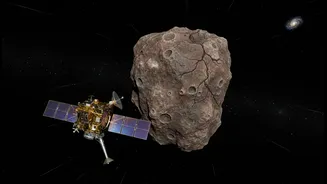
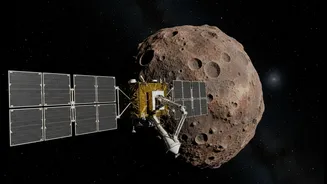
First, let's reacquaint ourselves with the star of the show. Hayabusa2 is the Japan Aerospace Exploration Agency (JAXA) probe that famously rendezvoused with asteroid Ryugu in 2018. For over a year, it mapped the diamond-shaped space rock, deployed tiny
rovers, and even blasted it with a projectile to create an artificial crater. Its primary mission culminated in December 2020 when it dropped off a capsule containing precious samples from Ryugu's surface and subsurface in the Australian desert, a historic first. Rather than retire the highly successful probe, JAXA sent it on an extended mission, dubbed Hayabusa2#. Using its remaining fuel, the spacecraft is now on a years-long journey to explore more of our solar system, with the Torifune flyby being its first major milestone on this new path.
Meet the Target: What is Torifune?
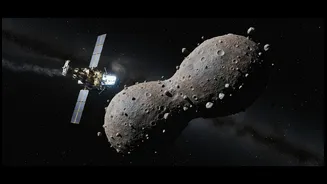
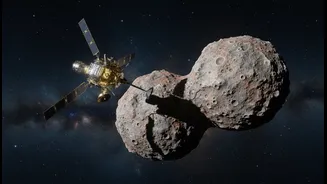
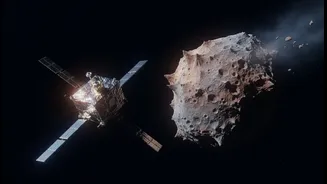
The subject of this recent flyby is the near-Earth asteroid officially known as 98943 Torifune. Discovered in 2001, it is about 450 meters (roughly 1,500 feet) across. Early telescopic observations suggested an elongated shape, but the new images from Hayabusa2 have provided a stunning confirmation: Torifune is a 'contact binary'. This means it's essentially two separate asteroids that have gently fused together, giving it a peanut or snowman-like appearance. The name 'Torifune' is an abbreviation of Ame-no-torifune from Japanese myth, a god's ship that can travel at high speed while remaining steady. This flyby was a crucial test of Hayabusa2's ability to track and observe an object at a relative speed of about 5 kilometers per second.
The Goals: More Than Just Pictures
While the close-up images of a new world are breathtaking, the Torifune flyby served several critical scientific and technical purposes. For JAXA, it was a valuable opportunity to test high-precision navigation and rapid reconnaissance techniques. The spacecraft had to autonomously track a small, dark object at high speed, skills that are vital for future exploration. More importantly, this mission has direct implications for planetary defense. Understanding the structure of asteroids like Torifune, which is classified as a 'rubble pile' of loosely bound rocks, helps scientists model how we might one day deflect a space rock that poses a threat to Earth. Data from the flyby will help researchers understand how contact binaries form and what their internal composition looks like.
The Key Instruments at Work
Hayabusa2 is equipped with a suite of sophisticated scientific instruments that were all put to use during the brief encounter. The main images you have likely seen were captured by the Optical Navigation Camera (ONC-T), the spacecraft's main telephoto lens. Beyond just visible light, the Thermal Infrared Imager (TIR) was used to measure Torifune's surface temperature and texture, giving clues about its material properties. A near-infrared spectrometer (NIRS3) worked to determine the composition of the minerals on the asteroid's surface, while a laser altimeter (LIDAR) would have been working to map its shape, had this been a longer rendezvous instead of a high-speed pass.
What to Watch For: The Data Unveiling
The flyby on July 5 was just the beginning. JAXA has confirmed it successfully received data from the probe and has already released initial images. In the coming weeks and months, scientists will be intensely analyzing the full dataset. Look out for press conferences and publications from JAXA detailing their findings. Key announcements will likely focus on the detailed structure of the two lobes, the nature of the 'neck' connecting them, the variety of boulders seen on the surface, and the thermal properties that reveal how the asteroid responds to sunlight. Every piece of information helps build a better 'zoo' of asteroids, improving our understanding of the solar system's formation.
What's Next for Hayabusa2?
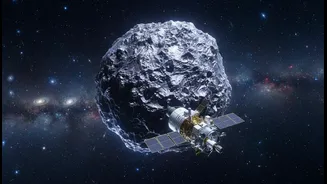
The Torifune encounter is a stepping stone, not the final destination. Hayabusa2 will now continue its journey, performing a pair of Earth flybys in 2027 and 2028 to adjust its trajectory. Its ultimate goal is a rendezvous in July 2031 with an even more challenging target: a tiny, rapidly rotating asteroid named 1998 KY26. This object is estimated to be only a few tens of meters in diameter and spins on its axis every 10.7 minutes. Reaching and studying such a small, fast-moving object will be an unprecedented feat of space exploration, pushing the boundaries of what's possible and providing crucial data on the most common type of potentially hazardous asteroids.