



The Language of Starlight
To understand how Webb works, we first need to appreciate the nature of light. The light from a star is a mixture of many different colours, or wavelengths, creating a spectrum. When this light passes through a gas, certain atoms and molecules in that
gas will absorb very specific wavelengths. Each chemical—whether it's water vapour, methane, or carbon dioxide—has a unique absorption pattern, like a chemical fingerprint or barcode. By looking at a star's light and seeing which specific colours are missing, scientists can identify exactly which chemicals the light has passed through. This fundamental principle is the key to unlocking the secrets of distant atmospheres.
Catching a Planet's Shadow
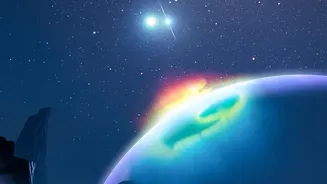
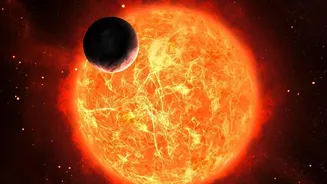
Astronomers can't just point Webb at an exoplanet and see its atmosphere directly; the planet is far too small and faint, completely lost in the glare of its host star. Instead, they use a clever technique called transmission spectroscopy. This method relies on a fortunate alignment: a planet passing directly in front of its star from our point of view, an event known as a transit. As the planet transits, a tiny fraction of the starlight filters through the thin ring of the planet's atmosphere. It’s during this brief moment that the chemicals in the atmosphere leave their tell-tale fingerprints on the starlight, absorbing specific wavelengths before the light continues its journey toward Webb's mirrors.
Webb’s Infrared Advantage
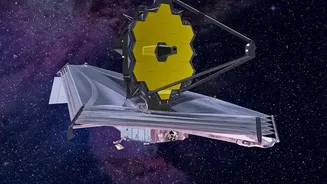
This is where the "Infrared" in James Webb Infrared Instruments becomes so crucial. While visible light can tell us some things, many of the most interesting molecules associated with life—including water, methane, and carbon dioxide—create their strongest and most distinct absorption fingerprints in the infrared part of the spectrum. Earth’s atmosphere blocks most infrared light, which is why a space-based telescope like Webb is essential for this work. By focusing on a wide range of infrared light, from near-infrared to mid-infrared, Webb can detect a much broader and more detailed catalogue of chemicals than was ever possible before, opening a new window into the composition of alien worlds.
The Tools of the Trade
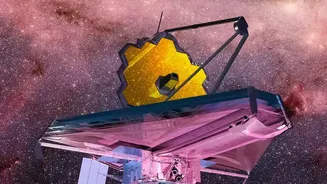
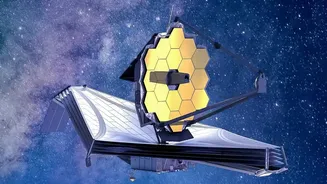
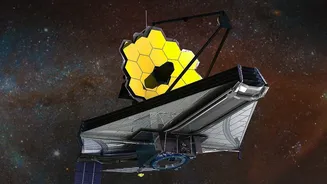
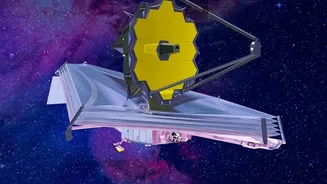
Webb is equipped with a suite of four powerful scientific instruments, but two are the primary workhorses for atmospheric analysis: NIRSpec (Near-Infrared Spectrograph) and MIRI (Mid-Infrared Instrument). These are not cameras in the traditional sense. They are spectrographs, meaning their job is to take the incoming light and split it into thousands of individual shades of colour. NIRSpec covers the near-infrared range (0.6 to 5.3 microns), while MIRI handles the mid-infrared (4.9 to 28.8 microns). Working together, they provide comprehensive coverage across the most vital infrared wavelengths. They capture the star's spectrum before, during, and after the transit. By subtracting the normal starlight from the light that passed through the atmosphere, astronomers are left with the absorption spectrum—the chemical barcode of the exoplanet's air.
From Data to Discovery
The result of an observation is not a pretty picture but a graph showing the brightness of light at each specific wavelength. Where there are dips in the graph, it signifies that a chemical in the exoplanet's atmosphere has absorbed that light. For example, when Webb studied the gas giant WASP-96 b, it found a distinct dip corresponding to the known absorption signature of water, confirming its presence with unprecedented clarity. For the planet K2-18b, Webb detected methane and carbon dioxide, and even tantalizing hints of dimethyl sulfide (DMS)—a molecule that, on Earth, is overwhelmingly produced by life. This process transforms abstract data points into profound discoveries about the nature of other worlds.