


A Cosmic Magnifying Glass
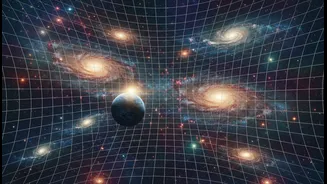
The technique at the heart of this discovery is called gravitational microlensing, and it works like a cosmic magnifying glass. The idea, first predicted by Albert Einstein, is based on his theory of general relativity, which showed that massive objects
warp the fabric of spacetime. When one star passes almost perfectly in front of another from our point of view, the gravity of the foreground star acts like a lens, bending and amplifying the light from the background star. For a brief period, the distant star appears to brighten significantly. If the foreground star has a planet, its much smaller gravitational field adds its own tiny, brief distortion—a short, sharp spike in the brightness. By carefully measuring that light curve, astronomers can deduce the presence of a planet they could never hope to see directly.
Meet Gaia23bra b
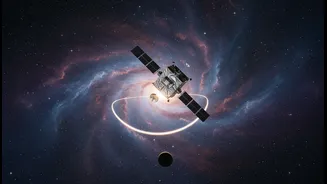
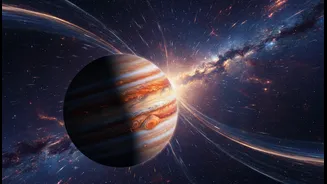
The newfound world, named Gaia23bra b, is a gas giant about 1.6 times the mass of Jupiter. It orbits an orange dwarf star 40,000 light-years away, at a distance similar to Jupiter's orbit around our sun. The first hint of its existence came in 2023, when the European Space Agency's Gaia telescope flagged a star that was brightening due to a microlensing event. The real breakthrough came when scientists checked archived data from NASA’s Transiting Exoplanet Survey Satellite (TESS). TESS, which happened to be watching that same patch of sky, had captured the event with much more frequent observations. This “denser time coverage” allowed researchers to spot the tell-tale secondary spike in brightness caused by the planet itself—a feat TESS was never expected to achieve.
A New Tool for a Tough Job
This discovery is a significant win because it adds a powerful new capability to NASA's planet-hunting arsenal. TESS was designed to find planets using the transit method, which detects the dimming of a star's light. That method is incredibly successful—accounting for about 75% of the 6,000+ exoplanets found so far—but it is most effective at finding very large planets that orbit very close to their stars. Microlensing is the opposite; it excels at finding planets in wider orbits, similar to those in our own solar system, as well as smaller, colder worlds. It is the only method sensitive enough to find free-floating "rogue" planets that don't orbit a star at all. By proving that TESS data can be used for microlensing, astronomers now have a way to search for a completely different class of planets that were previously hidden from them.
A Preview of a Planetary Census
This success with TESS is seen by many in the astronomy community as a preview of what's to come. NASA's next great observatory, the Nancy Grace Roman Space Telescope, is scheduled to launch in August 2026 with a primary mission to conduct a massive microlensing survey. Roman will stare at the dense, star-packed center of our galaxy, where microlensing events are more common, observing hundreds of millions of stars. Scientists predict that Roman’s survey will be revolutionary, potentially discovering around 1,400 planets via microlensing and another 100,000 through transits. This single mission could multiply the total number of known exoplanets many times over, providing an unprecedented census of the planets in our galaxy and transforming our understanding of planetary formation.