






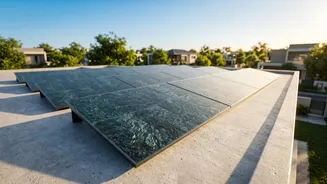

What Exactly Are Perovskite Solar Cells?
For decades, solar panels have relied on silicon. Think of silicon as the sturdy, reliable workhorse of the solar world. Perovskite solar cells are the new, highly-talented challenger. Named after their specific crystal structure, these cells are made
from a family of synthetic materials that are remarkably good at converting sunlight into electricity. Unlike silicon, which requires high-purity crystals grown at scorching temperatures, perovskite materials can be mixed into a liquid and essentially 'printed' like ink. This simpler, low-temperature manufacturing process is a key reason for the excitement—it promises to make solar panels much cheaper to produce.
The Breakthrough: More Power, Less Space
The main buzz around perovskites is their incredible efficiency. In lab settings, perovskite cells are already rivaling, and in some cases surpassing, the best silicon cells. The most exciting development is the 'tandem' cell, which stacks a thin, semi-transparent perovskite layer on top of a traditional silicon cell. This dynamic duo captures a much wider spectrum of sunlight. The perovskite layer grabs the high-energy blue light, while the silicon layer below soaks up the lower-energy red light. This teamwork approach has resulted in certified lab efficiencies smashing past 34%, a figure well beyond what silicon can achieve on its own. For homeowners, this means generating more power from a smaller roof area.
Beyond Rooftops: The Flexibility Advantage
Because perovskites can be printed onto flexible surfaces, they open a world of possibilities that are impossible for rigid silicon panels. Imagine solar-powered windows that look like tinted glass, or curved building facades that generate electricity. Researchers are even developing lightweight versions that could be rolled out like a carpet, integrated into the roof of a car, or even woven into fabrics for portable power on the go. An Indian company, P3C Technology, is already developing both glass-based and flexible perovskite modules in Gurugram, aiming to harness this versatility. This adaptability could be a game-changer, especially in urban environments where space is limited.
The Big Hurdle: Can It Last?
So, if perovskites are so amazing, why aren't they on every roof already? The single biggest challenge has been durability. Early versions of perovskite cells degraded quickly when exposed to heat, moisture, and even continuous sunlight—the very conditions a solar panel must endure. This is a major concern, particularly in India's demanding climate. However, recent breakthroughs in 2026 are tackling this head-on. Scientists have developed new chemical additives and 'molecular press' techniques that create a more robust crystal structure, significantly slowing down degradation. Companies are now creating modules that pass industry-standard stress tests, a crucial step toward commercial viability.
The Timeline for Indian Homes
The transition from lab record to a product you can buy is already underway. The first commercial-scale tandem modules are beginning to ship globally, though initially for premium projects. For mass-market residential adoption in India, the consensus points to a 2027-2028 timeframe as manufacturing scales up and long-term field data proves the technology's reliability. The Indian government is also taking notice, with the Ministry of New and Renewable Energy earmarking funds in July 2026 for a pilot perovskite manufacturing line to boost domestic production. This signals a strong push to make India a leader in this next-generation solar technology, not just a consumer.