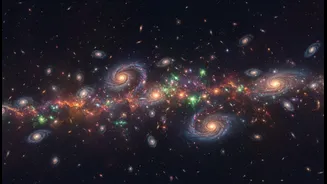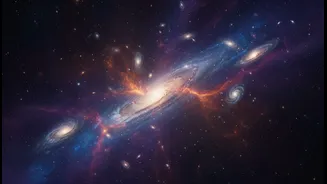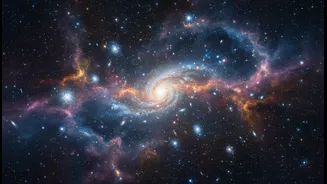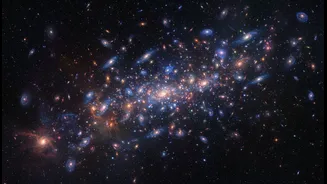

An Unexpected Cosmic Snapshot
For decades, our best models of the universe told a consistent story about its childhood. The period shortly after the Big Bang, known as 'cosmic dawn', was supposed to be chaotic and gradual. Scientists expected to find small, messy, and disorganized
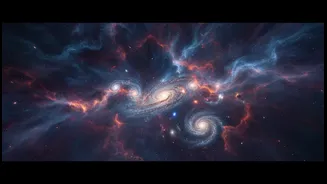
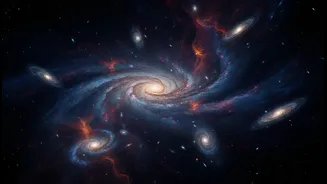
clumps of stars slowly merging to form the first 'toddler' galaxies. These early structures were predicted to be turbulent and lacking the elegant shapes of modern galaxies like our own Milky Way. But the JWST, with its powerful infrared eyes, has sent back images that throw a wrench in this tidy narrative. Instead of cosmic toddlers, it's finding galaxies that look like they've already hit their teenage years, complete with complex structures that were thought to take billions of years to develop.
What Makes a Galaxy 'Modern'?
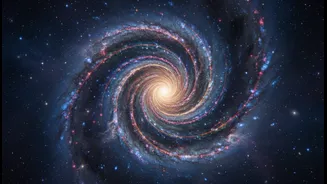
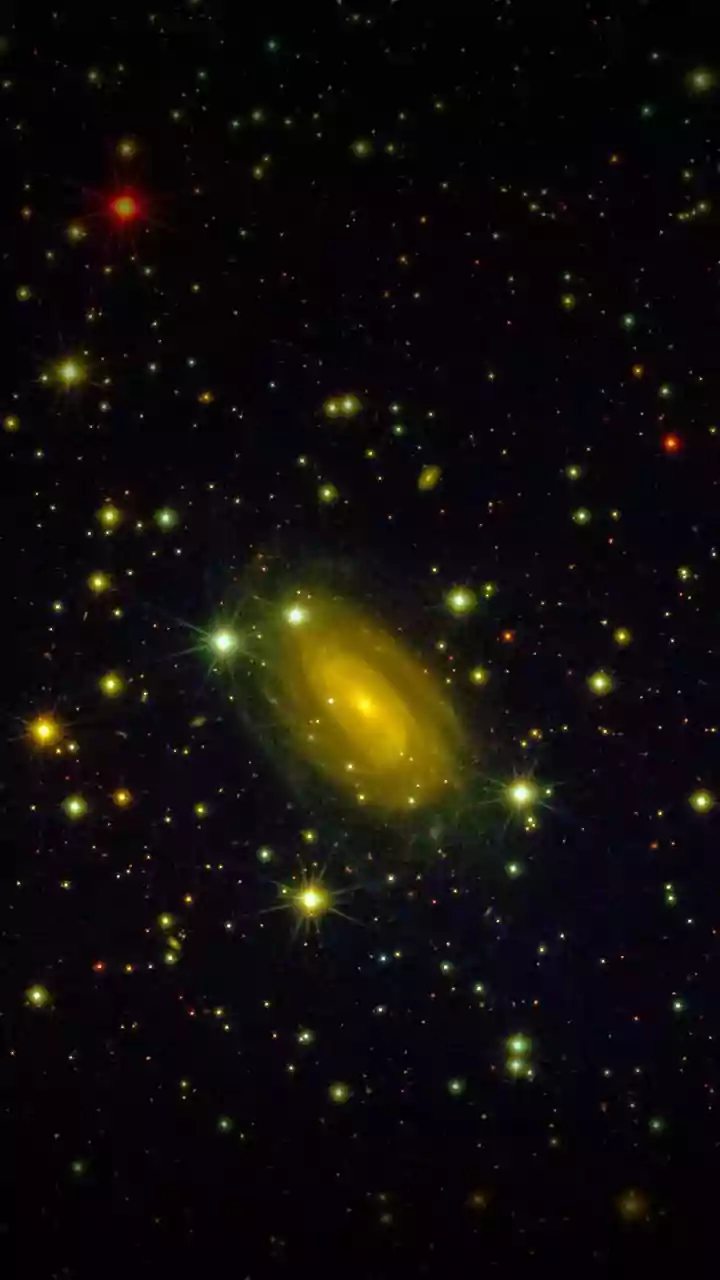
When astronomers describe these early galaxies as 'surprisingly modern' or 'mature', they are referring to specific, highly-organized features. The most startling of these is the 'stellar bar'—a long, bright band of stars that cuts across the galaxy's center. Our own Milky Way has a bar, and they are common in the present-day universe. These bars act like giant cosmic conveyor belts, funneling gas and dust toward the galactic core. This process is incredibly efficient at triggering furious bursts of star formation and feeding the supermassive black hole at the galaxy's heart. Previously, it was believed that the hot, gassy, and turbulent conditions of the early universe would prevent these stable structures from forming so soon. Finding them in galaxies that existed just two to four billion years after the Big Bang is like finding a skyscraper in a neolithic village.
Rewriting the Galactic Growth Chart
The existence of these advanced features so early on directly challenges the standard 'hierarchical' model of galaxy formation. This model posits that large, structured galaxies are built slowly, piece by piece, over immense timescales. The discovery of galaxies like GN-z11 and others, which are not only structured but also brighter and more numerous than expected, suggests that this process happened much, much faster. It's not just about one or two oddball galaxies; JWST is revealing a consistent pattern of early maturity. This forces scientists to ask fundamental questions: Were the initial conditions of the universe different than we thought? Does star formation work more efficiently in the dense, pristine gas of the early cosmos? Or is there something about the mysterious nature of dark matter that we’ve misunderstood?
The Hunt for an Explanation
Researchers are now scrambling to adjust their theories to fit the new evidence. One leading idea is that star formation in the early universe was simply more efficient than it is today. Without the heavy elements created by generations of stars, the gas clouds might have collapsed more readily. Another theory suggests that the 'feedback' from early stars—the energetic winds and radiation they blast out—was less effective at stopping new star formation than previously thought. Recent research from Durham University, published in July 2026, provided direct evidence of a bar building a dense 'nuclear disc' of stars at a galaxy's core over nine billion years ago, confirming these structures were actively shaping galaxies far earlier than assumed. Scientists are now planning further observations to study how gas and stars move within these ancient galaxies to understand exactly how these structures formed and how quickly they grew.
Why This Cosmic Mystery Matters
While the debate over galactic timelines might seem abstract, it touches on some of the most profound questions about our origins. Understanding how and when galaxies like our own formed is crucial to understanding the story of the universe, and our place within it. These discoveries are a powerful testament to the capability of the James Webb Space Telescope, a pinnacle of human engineering that is allowing us to see the cosmos with unprecedented clarity. Each new image that challenges our assumptions isn't a failure of science, but a victory for it. It proves that the universe is still full of surprises and that our quest to understand it has just entered an exciting new chapter.