


Earth's Giant Magnetic Bubble
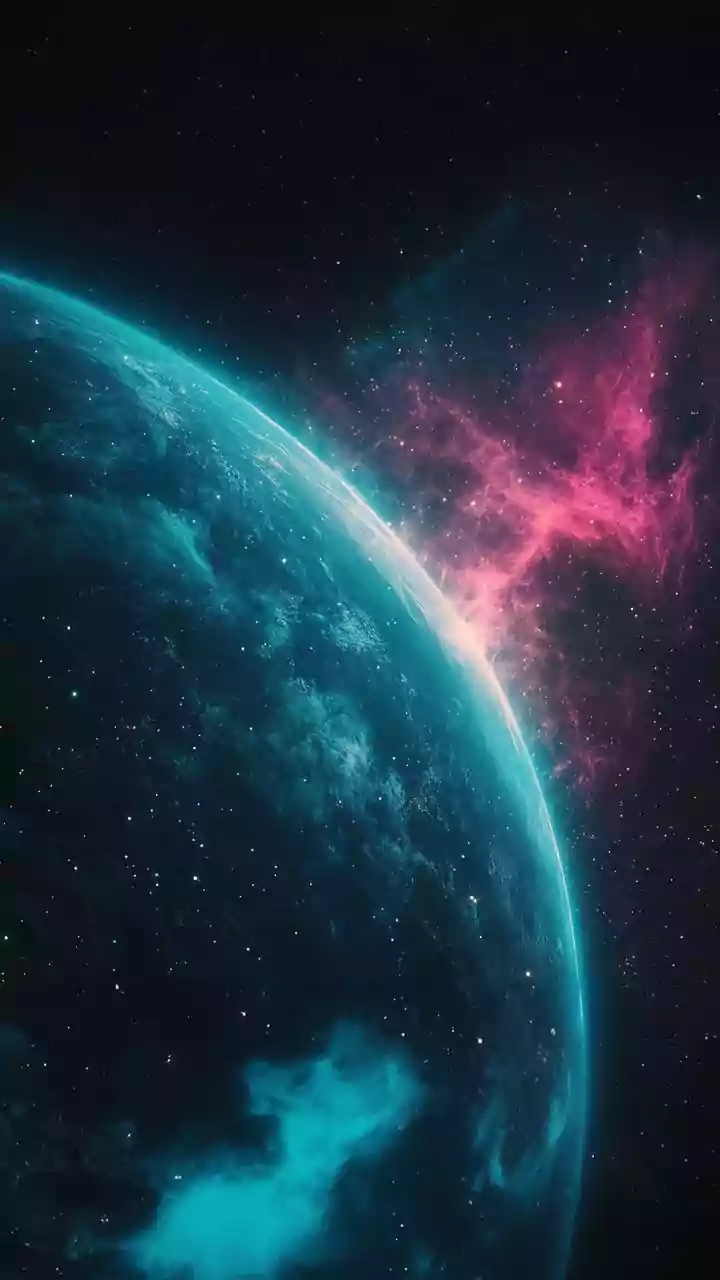
Imagine Earth as having a giant bar magnet at its core. This isn't just an analogy; the movement of molten iron in our planet's outer core generates powerful electric currents, creating a vast magnetic field that extends far into space. This field forms
a protective bubble called the magnetosphere. On the side facing the sun, this bubble is compressed by the solar wind, a relentless stream of charged particles flowing from the sun. On the night side, it's stretched out into a long tail, like a comet. Without this magnetic shield, the solar wind would strip away our atmosphere, making life impossible. The magnetosphere deflects most of these particles, guiding them around our planet.
Discovering the Radiation Donuts
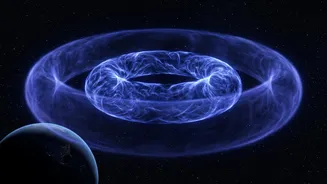
In 1958, America's first satellite, Explorer 1, carried a simple Geiger counter into orbit. Scientist James A. Van Allen, who designed the instrument, was shocked by the readings. They showed radiation levels a thousand times higher than expected from cosmic rays alone. Scientists quickly realised these weren't just passing particles; they were trapped. This discovery revealed two massive, doughnut-shaped zones of highly energetic charged particles encircling the Earth, now known as the Van Allen radiation belts. There is an inner belt, composed mainly of high-energy protons, and an outer belt, dominated by energetic electrons.
Where Do the Particles Come From?
The particles trapped in these belts have two main origins. The inner belt is primarily populated by protons created when high-energy cosmic rays from deep space smash into atoms in Earth's upper atmosphere. This collision creates neutrons, some of which are ejected back into space where they decay into the protons and electrons that get trapped. The outer belt gets its particles mostly from the solar wind. Particles from the sun, mainly electrons and some ions, manage to penetrate the magnetosphere and become ensnared by its magnetic field lines.
The Magnetic Mirror Trap
So, how exactly does the magnetosphere trap these particles? The mechanism is known as the 'magnetic mirror effect'. As a charged particle encounters a magnetic field line, it doesn't just follow it straight down; it begins to spiral around it. Earth's magnetic field lines are weakest at the equator and get progressively stronger and denser as they converge near the North and South Poles. As a spiralling particle travels towards a pole, it enters this stronger field. The increasing magnetic force acts like a mirror, slowing the particle's forward motion until it stops and is reflected back towards the opposite hemisphere. This causes the particles to bounce back and forth between the poles for years, trapped in a cosmic game of ping-pong.
Why the Belts Matter
The Van Allen belts are more than just a scientific curiosity. They form a crucial part of our planet's defence against radiation, but they also pose a significant hazard to technology and human spaceflight. Satellites for GPS and communications must be designed with radiation-hardened electronics to survive passage through the belts. For human missions, like the Apollo flights to the Moon, astronauts had to travel through the belts as quickly as possible on carefully chosen trajectories to minimise radiation exposure. Sometimes, particles escape the belts near the poles and collide with atmospheric gases, creating the spectacular light shows we know as the auroras. This makes the belts both a beautiful and dangerous feature of our near-Earth environment.