


The Downhill Dilemma
While charging up a hill taxes your cardiovascular system, the journey back down is what truly tests your knees. Each downhill step requires your quadriceps muscles to act as brakes to control your speed and prevent a tumble. This braking action is a type
of muscle work called an eccentric contraction, where the muscle lengthens under tension. The repetitive, high-impact nature of this movement places significant strain on the patellar tendon, which connects your kneecap to your shinbone. Over time, this can lead to irritation, inflammation, and the all-too-common anterior knee pain often broadly labelled as 'runner's knee'. Unlike the concentric (shortening) action of pushing off, this eccentric loading is where the damage often occurs.
The Science of 'Slow-Eccentric'
The solution lies in training your muscles and tendons to better handle these specific forces. This is where slow-eccentric exercises come in. The 'eccentric' part mimics the downhill braking motion, while the 'slow' component is crucial. Performing the lowering phase of an exercise in a slow, controlled manner, typically over three to five seconds, increases the time your muscle is under tension. This targeted stress stimulates the cells within your patellar tendon to produce more collagen, the protein that gives tendons their strength and structure. This process helps remodel and repair the tendon fibres, making them thicker, stronger, and more capable of absorbing the forces of downhill running without complaint.
Key Exercise: The Slow-Eccentric Squat
The most fundamental and effective exercise for building this resilience is the slow-eccentric squat. You don't need any special equipment to get started. Stand with your feet shoulder-width apart. Begin the movement by pushing your hips back and bending your knees, as if sitting in a chair. The key is the tempo: count slowly to five as you lower yourself until your thighs are parallel to the ground or just below. Keep your chest up and your back straight. Once at the bottom, don't pause. Push back up to the starting position at a normal, controlled speed. The focus is entirely on that slow, deliberate descent. This trains the quadriceps to manage load while lengthening.
Advanced Move: The Single-Leg Decline Squat
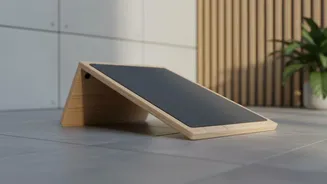
For those looking to advance the movement, or for those whose physical therapist recommends it, the single-leg decline squat is a gold-standard exercise in patellar tendon rehabilitation. You can create a slight decline with a slant board or by placing your heels on a small weight plate. Stand on one leg. Slowly, over a count of five, bend your standing knee and lower your body, keeping your other leg extended in front of you for balance. Go as low as you can without pain, then use both feet to push yourself back to the starting position. This isolates the eccentric load on one leg, providing a more intense stimulus for tendon adaptation. It is a powerful exercise that should be approached with care and excellent form.
Integrating Into Your Routine
To be effective, these exercises must be done consistently. Aim to incorporate them into your strength training routine two to three times per week, preferably on non-running days or after a run, not before. Start with bodyweight only, focusing intently on form and the slow, controlled lowering phase. Aim for 3 sets of 10-15 repetitions. As you get stronger, you can add a light weight, but the priority should always be the tempo and control, not the amount of weight lifted. Proper execution is what signals the tendon to adapt and grow stronger, ultimately providing the protection you need on the hills.