



A Ghostly Survivor in the Cosmos
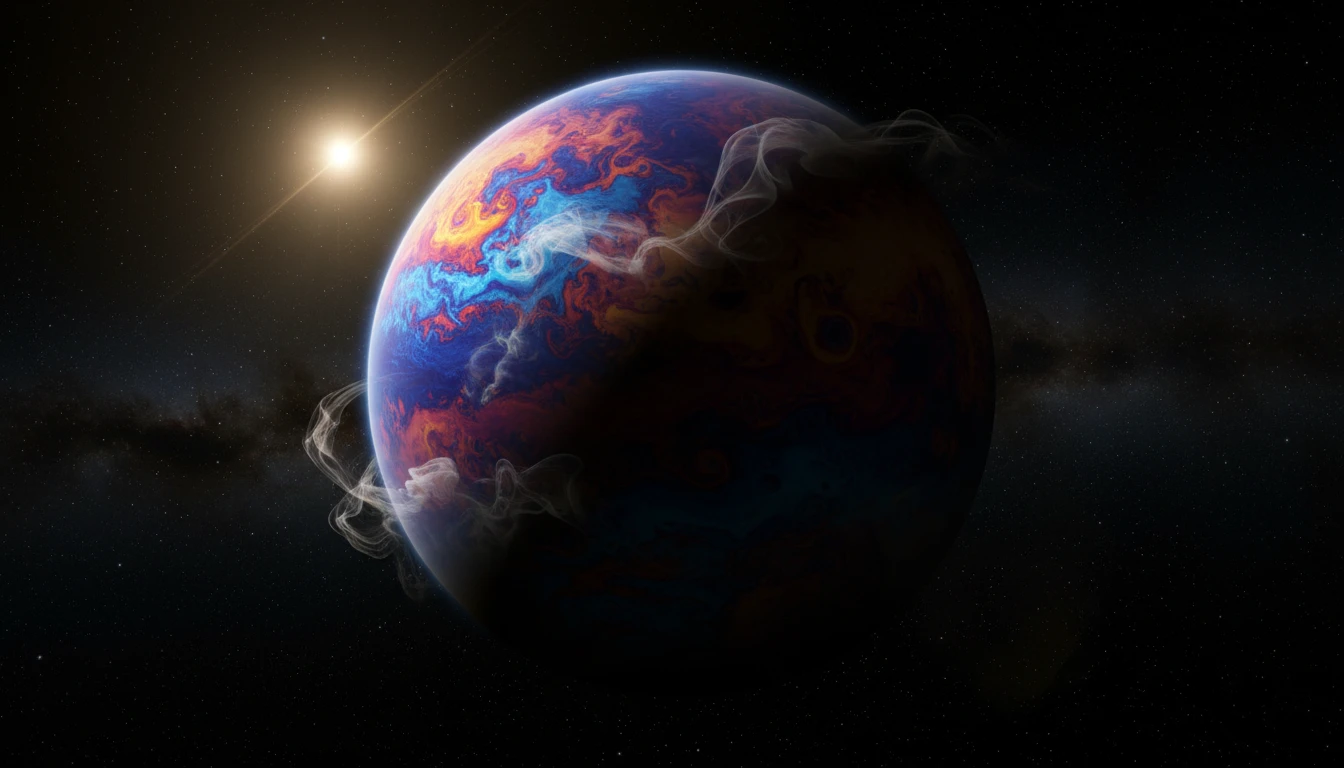
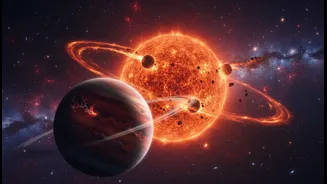
Astronomers have been captivated by a strange system located about 80 light-years away. There, a gas giant planet named WD 1856 b, roughly the size of Jupiter, speeds around its star in a mind-boggling 34 hours. What makes this truly bizarre is the star itself:
it's a white dwarf, the collapsed, Earth-sized corpse of a star that was once like our Sun. By all accounts, the planet should not exist. When its star swelled into a massive red giant billions of years ago—a violent phase of stellar death—it should have incinerated or flung away any nearby planets. Yet, WD 1856 b is there, orbiting in the star's former kill zone, posing a cosmic mystery that scientists have been desperate to solve.
The Life and Death of a Star
To understand the puzzle, you need to know about the final, dramatic acts of stars like our Sun. For billions of years, they fuse hydrogen into helium in their cores. When that fuel runs low, they enter a 'red giant' phase, swelling to hundreds of times their original size and consuming their inner planets. For our solar system, that means Mercury and Venus are doomed, and Earth's fate hangs in the balance. After this destructive expansion, the star sheds its outer layers, leaving behind a hot, incredibly dense core called a white dwarf. This stellar remnant is no longer a fusion engine; it's a cooling ember that will slowly fade over trillions of years. Finding an intact planet snuggled up against a white dwarf was, until recently, thought to be nearly impossible.
A Planet's Grand Journey
Thanks to new, detailed observations from the James Webb Space Telescope, the mystery of WD 1856 b's survival is finally being unraveled. Scientists discovered that the planet is much warmer than it should be, sitting at a surprisingly balmy 126 degrees Celsius. This heat isn't coming from the dim white dwarf; it's leftover energy from a violent past event. The leading theory is that the planet didn't start its life this close. It survived the red giant phase by being in a distant, safe orbit. Billions of years after its star had died, something—perhaps the gravitational nudge from two other companion stars in the same system—kicked the planet into a new path, sending it spiraling inward toward the white dwarf.
Forged by Gravity's Squeeze
This inward migration was the key to its transformation. As WD 1856 b got closer to the immense gravity of the white dwarf, it was squeezed and stretched in a process called tidal heating. This cosmic workout generated a tremendous amount of internal friction, heating the planet from the inside out and giving it the elevated temperature we see today. It also marks the first time scientists have detected an atmosphere, complete with methane and hazy clouds, around a planet orbiting a dead star. This confirms that planets can indeed have a vibrant, if chaotic, second act long after their parent star has gone dark. These findings, published in the journal Nature, paint a picture of a dynamic and evolving graveyard system.
A Glimpse of Our Solar System's Future
This bizarre system is more than just an astronomical curiosity; it's a time machine that lets us look forward into our own solar system's distant future. In about five billion years, our Sun will also become a white dwarf. While Earth's survival is uncertain, this discovery strongly suggests that our own gas giants, Jupiter and Saturn, will likely survive the Sun's death throes. They may not stay in their current orbits, but could be shuffled around, perhaps even migrating closer to the dying embers of our Sun. The study of WD 1856 b shows that the death of a star isn't the end of its planetary system, but rather the beginning of a strange and fascinating new chapter.