








The Matrix (1999)
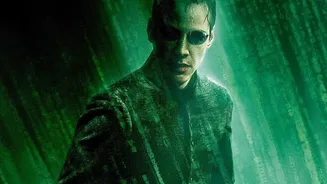
What if the world you know is a lie? This is the question that catapulted The Matrix into a cultural phenomenon. The film follows a computer hacker named Neo who discovers that his reality is a sophisticated computer simulation created by intelligent
machines to enslave humanity. He is given a choice: take the blue pill and remain in blissful ignorance, or take the red pill and see the terrifying truth. The film masterfully blends high-octane action with deep philosophical questions about free will, control, and the nature of existence itself. It brought the simulation theory, an idea once confined to philosophy papers, into the mainstream conversation, forcing audiences to wonder, just for a second, if our world is as real as it seems.
Inception (2010)
From the mind of Christopher Nolan comes a heist movie unlike any other. Instead of stealing money or jewels, Dom Cobb and his team are corporate spies who steal valuable secrets by entering people's dreams. Their latest job is their most challenging yet: not to steal an idea, but to plant one—an act known as "inception." To do this, they must construct a multi-layered dream world, a dream within a dream, within another dream. The film is a visually spectacular puzzle box that explores the power of the subconscious mind. As the lines between the dream levels blur, both the characters and the audience are left questioning what is real and what is merely a projection of the mind, right up to its famously ambiguous final shot.
Arrival (2016)
While many sci-fi films focus on conflict, Arrival is a profound story about communication. When twelve mysterious alien spacecraft touch down across the globe, linguist Dr. Louise Banks is tasked with deciphering their complex language to understand their purpose. The film's mind-bending concept is rooted in a linguistic theory known as the Sapir-Whorf hypothesis, which suggests that the language you speak shapes how you perceive reality. As Louise becomes more fluent in the aliens' language, her perception of time begins to change, allowing her to experience the past, present, and future simultaneously. It’s a beautifully intelligent film that uses its sci-fi premise to tell an intimate and powerful story about choice, love, and the human experience.
Blade Runner 2049 (2017)
A stunning sequel to the 1982 classic, this film delves even deeper into questions of what it means to be human. In a future where bioengineered humans called Replicants are used for slave labour, Officer K, himself a Replicant, uncovers a secret that could plunge society into chaos. His investigation becomes a personal journey of self-discovery, as he grapples with implanted memories, feelings of love for a holographic AI companion, and the longing for a soul. Blade Runner 2049 is a slow-burn, atmospheric masterpiece that challenges our definitions of consciousness, memory, and identity. It argues that being human might not be about how you were born, but about the choices you make and the connections you forge.
Eternal Sunshine of the Spotless Mind (2004)
Can you erase a person from your memory? And more importantly, should you? This film blends romance, comedy, and science fiction to tell the story of a heartbroken couple, Joel and Clementine, who undergo a procedure to have their memories of each other erased. As Joel's memories are deleted one by one, he revisits the moments of their relationship in reverse, from the bitter end to the beautiful beginning. He soon realizes that even the painful memories are a part of who he is and that he doesn’t want to let them go. It’s a brilliantly inventive and emotionally resonant film that explores how our memories, both good and bad, construct our identity. The story suggests that true healing comes not from forgetting, but from accepting the entirety of our experiences.