







A New Era of Accessibility
Thanks to a sustained focus on improving connectivity under government initiatives like the Act East Policy, PM-DevINE, and the North East Special Infrastructure Development Scheme (NESIDS), travel to and within the eight states of Northeast India is
undergoing a revolution. Once considered a remote frontier, the region is rapidly transforming into a crucial gateway to Southeast Asia, with thousands of kilometres of new roads, railway lines, and upgraded airports making journeys faster, safer, and more reliable. This has led to a surge in tourism, with domestic visitor numbers showing significant growth. For travellers, this means that destinations that once required days of arduous journeys are now within much easier reach.
Taking to the Skies: Air Travel Transformed
Air travel has become a game-changer for the Northeast. The number of operational airports in the region has nearly doubled, growing from nine in 2014 to 17. All eight states now have air connectivity. The government's UDAN (Ude Desh ka Aam Naagrik) scheme has been pivotal, operationalising around 90 new routes that connect smaller towns with major cities, often with capped fares to ensure affordability. Key developments include the Donyi Polo Airport in Arunachal Pradesh, which has drastically cut travel time to popular spots like Tawang and Ziro, and the Pakyong Airport in Sikkim. Other airports in Imphal, Tezu, and Shillong have also seen upgrades, opening up new opportunities for tourism and local economies. The Ministry of Civil Aviation is further encouraging the development of new greenfield airports to boost connectivity even more.
On the Right Track: Railways Push into New Frontiers
The Indian Railways is aggressively expanding its network to connect all state capitals in the Northeast. States like Mizoram, Manipur, and Nagaland, which had minimal rail presence, are now being integrated into the national broad-gauge network. Major projects are underway, including the 51 km Bairabi-Sairang line to connect Mizoram's capital, Aizawl, and the challenging 111 km Jiribam-Imphal line in Manipur, which is expected to bring the state capital onto the railway map. In Nagaland, the Dimapur-Kohima line is progressing, with the goal of connecting Kohima by rail. Furthermore, electrification of the network is a high priority, with new electric train services like the Agartala-Karimganj MEMU service being introduced to offer faster and more efficient travel. These projects are not just about passenger travel; they are also creating strategic trade corridors, including a cross-border line to Bhutan.
The Road Ahead: A Revolution in Highway Network
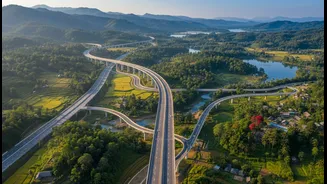
For a region where roads are the primary lifeline, the ongoing highway development is perhaps the most visible transformation. The length of National Highways in the Northeast has expanded significantly over the last decade. Tens of thousands of kilometres of rural roads have also been built under the Pradhan Mantri Gram Sadak Yojana (PMGSY), improving last-mile connectivity. Ambitious projects like the Shillong–Silchar and Jorabat–Barapani greenfield corridors are set to slash travel times between major hubs like Guwahati, Shillong, and Silchar by as much as 50%. In Arunachal Pradesh, the Trans-Arunachal Highway is opening up once-inaccessible valleys. While challenges like monsoons and landslides persist, as seen on the Imphal-Jiribam highway, the push to create all-weather roads continues with deadlines set for completion.
How to Plan Your Trip Now
With these developments, planning a trip to the Northeast is a completely new experience. Culture-focused tourists can now fly directly to Itanagar (via Donyi Polo Airport) to explore Arunachal Pradesh, or to Shillong to soak in the music and nature of Meghalaya, saving days of road travel. Backpackers and adventure seekers can leverage the expanding rail network to reach the foothills of Nagaland or Mizoram before venturing further. For residents, the improved roads mean that interstate travel for work or leisure is far more feasible. For instance, the journey from Guwahati to Shillong is set to become just an hour long. The key is to check the latest flight schedules, train timetables, and local road conditions before you travel, as new routes and services are frequently being added. Government schemes like Swadesh Darshan and PRASHAD are also developing specific tourist and pilgrimage circuits, making it easier to plan thematic tours.