

A Water World Hiding in Plain Sight
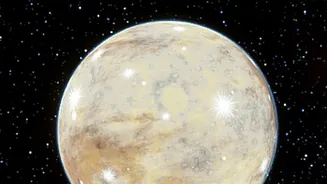
Slightly smaller than Earth's moon, Europa is a world encased in ice. Its surface is a crisscrossing puzzle of cracks and reddish-brown streaks, but with very few craters, suggesting it is geologically young and active. The strongest evidence for what
lies beneath comes from NASA's Galileo mission in the 1990s, which detected a distorted magnetic field around the moon. Scientists believe this is caused by a global ocean of electrically conductive salty water. This ocean could contain more than twice the amount of water found in all of Earth's oceans combined, locked away from the sun in perpetual darkness.
Meet the Clipper: A Strategic Explorer
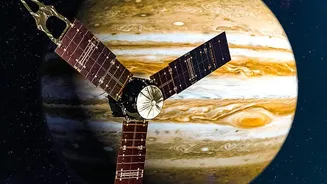
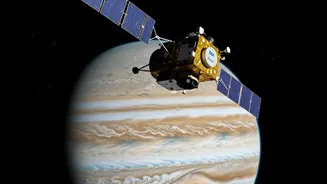
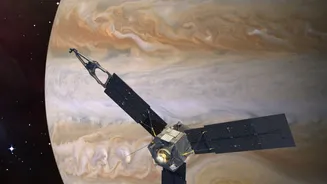
Launched in October 2024, the Europa Clipper spacecraft is undertaking a nearly six-year journey to the Jupiter system, scheduled to arrive in April 2030. It won't orbit Europa directly, as that would expose it to Jupiter’s fierce radiation. Instead, it will orbit Jupiter and perform dozens of close, strategic flybys of Europa. During its four-year science mission, Clipper will swoop from altitudes as high as 2,700 kilometers down to a nail-biting 25 kilometers (about 16 miles) above the surface. This strategy allows it to scan nearly the entire moon while minimizing radiation damage.
Searching for Habitability, Not Aliens
A crucial point about the Europa Clipper mission is that it is not designed to find life itself. Its primary goal is to determine if Europa is habitable—that is, whether it possesses the three key ingredients believed to be necessary for life as we know it: liquid water, essential chemistry, and a source of energy. Finding out if Europa has the right conditions is the critical first step before any future mission might be sent to search for actual organisms. The mission will investigate the thickness of the ice shell, the depth and saltiness of the ocean, and the moon's overall geology and chemical makeup.
A Toolkit for an Alien Ocean
To achieve its goals, Clipper is equipped with a powerful suite of nine science instruments. The Radar for Europa Assessment and Sounding: Ocean to Near-surface (REASON) instrument will act like a penetrating sonar, aiming to measure the thickness of the ice shell and locate any pockets of water within it. A magnetometer will precisely measure the magnetic field to confirm the ocean's existence and estimate its depth and salinity. High-resolution cameras will map the fractured surface in stunning detail, looking for signs of recent geologic activity.
What Plumes Could Reveal
One of the most exciting prospects is the potential that Europa is venting water from its ocean into space through plumes, similar to those seen on Saturn's moon Enceladus. If these plumes exist, Clipper could fly through them. Instruments like the MAss Spectrometer for Planetary EXploration (MASPEX) and the SUrface Dust Analyzer (SUDA) could directly sample this material. This would offer a 'free sample' of the ocean's composition without needing to drill through miles of ice. These instruments will analyze the chemical makeup of any captured particles, searching for the complex organic molecules that are building blocks of life.
The Big Questions on the Table
By the end of its mission, scientists hope Europa Clipper will have answered some of humanity's most profound questions about this icy moon. Is there a liquid water ocean, and how thick is the ice shell protecting it? How salty is the water, and what is it made of? Does the ocean floor have hydrothermal vents, which on Earth provide energy for entire ecosystems? Are there pockets of warmer water closer to the surface? Answering these questions won't just tell us about Europa; it will fundamentally advance our understanding of the potential for life to exist on other worlds across the cosmos.