


The Problem with Staying in Orbit
For every satellite operating in Low Earth Orbit (LEO), the clock is always ticking. Even hundreds of kilometres up, the atmosphere isn't a perfect vacuum. Scarce air molecules create a persistent drag, causing satellites to gradually lose altitude. To
counteract this, they must fire their thrusters, but this requires carrying propellant. Once the fuel runs out, the mission is effectively over, and the satellite eventually falls back to Earth and burns up. This fundamental limitation dictates mission lifetimes, increases costs due to replacement launches, and restricts operations in Very Low Earth Orbits (VLEO) below 300 kilometres, where the atmospheric drag is much stronger but the potential rewards—like higher-resolution imagery and lower-latency communications—are significant.
Turning a Foe into Fuel
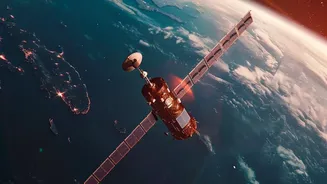
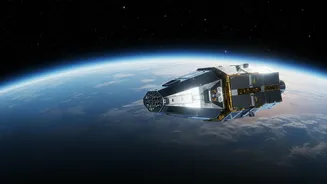
This is where air-breathing electric propulsion (ABEP) comes in, a revolutionary concept that flips the script on orbital mechanics. Instead of carrying its own propellant, an ABEP-equipped satellite would use a specially designed intake to scoop up the residual atmospheric particles it encounters at high orbital speeds. These captured molecules, primarily nitrogen and oxygen, are then ionised—given an electric charge—inside a thruster. Using power generated by solar panels, an electric field then accelerates these ions and ejects them at high velocity. This creates thrust, counteracting the atmospheric drag with the very substance that causes it. In essence, the system allows the satellite to “breathe” the atmosphere, potentially extending its operational life for years.
The Global Race to Build Air-Breathers
The idea of air-breathing propulsion has been around since the 1960s, but only recently has technology caught up to the concept. The European Space Agency (ESA) has been a major driver, funding projects and successfully testing ground-based prototypes. One notable project, led by Italian aerospace company Sitael, produced and tested the world's first air-breathing thruster called RAM-EP. These tests, conducted in vacuum chambers simulating the environment at 200 km altitude, proved the concept was viable. More recently, a project by TransMIT GmbH and Bundeswehr University Munich, also funded by ESA, passed a critical design review in March 2026 for a novel cathodeless thruster, a key step in making these systems more robust and efficient. Similar research is underway in Japan, with JAXA developing its own Air-Breathing Ion Engine (ABIE), and in the UK with a team at the University of Surrey. In India, Ahmedabad-based startup Orbitt Space is also developing an air-breathing propulsion platform.
New Possibilities in a Lower Orbit
If perfected, this technology could unlock a new era of space operations. Satellites could operate for extended periods in VLEO, offering unprecedented benefits. For Earth observation, orbiting closer means higher-resolution images without needing larger, more expensive optics. For telecommunications, it means lower latency, a key advantage for services competing with terrestrial fibre. These long-lived platforms could also function as persistent surveillance assets or serve as reusable space tugs, moving other objects in orbit. The technology isn't limited to Earth; an air-breathing thruster could theoretically use the carbon dioxide in Mars's thin atmosphere to explore the Red Planet from low altitudes.
Challenges and the Path Forward
While the headline promise of sustaining satellites “indefinitely” is compelling, significant technical hurdles remain. Operating in VLEO means dealing with a highly corrosive environment, particularly due to atomic oxygen, which can degrade spacecraft materials. The system must also be incredibly efficient, generating enough thrust to overcome drag in a narrow operational window where the atmosphere is dense enough to be harvested but not so dense that it overwhelms the satellite. Current ground tests have demonstrated the principle, but the next step is proving a fully integrated system can operate reliably in the harsh reality of space. Developers are now focused on scaling up the technology and improving the design of both the intake collectors and the thrusters to make them more efficient and durable for long-duration missions.