




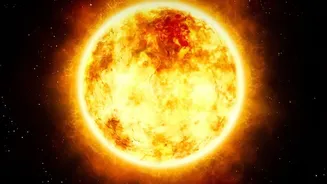
The Sun’s Volatile Nature
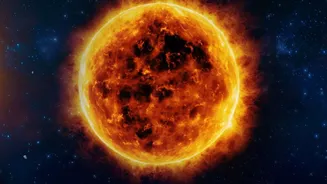
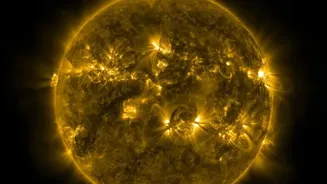
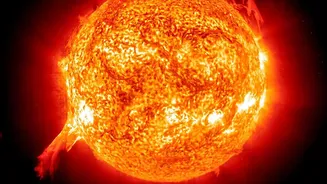
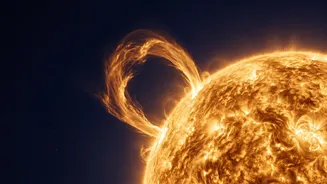
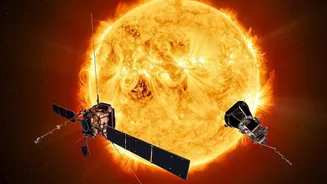
Though it appears as a steady source of light and warmth from 93 million miles away, the Sun is a dynamic and often violent star. It constantly sends out a stream of charged particles called the solar wind. More dramatically, it can unleash solar flares—immense
bursts of radiation—and coronal mass ejections (CMEs), which are colossal clouds of solar plasma and magnetic fields hurled into space. When these events are directed at Earth, they create what scientists call space weather. While they can produce beautiful auroras, they also pose a significant threat to our way of life.
A Threat to Our Wired World
Our dependence on technology makes us uniquely vulnerable to severe space weather. A powerful CME can interact with Earth's magnetic field and induce powerful electrical currents on the ground. These currents can overload and damage transformers in our power grids, leading to widespread and long-lasting blackouts. In orbit, the danger is just as real. Satellites responsible for everything from GPS navigation and financial transactions to television broadcasts and weather forecasting can be disrupted or permanently damaged by high-energy particles. This disrupts communications, air travel, and nearly every sector of the modern economy.
The Challenge of Forecasting
For decades, predicting the specific impact of a solar storm has been a massive challenge. Scientists could see a CME erupt from the Sun, but knowing exactly when and where its effects would be felt on Earth was difficult. Existing models were often slow, requiring hours of analysis by human experts, and could only provide general warnings. This limited the ability of power grid operators and satellite companies to take protective measures. With the Sun's activity expected to peak in its current 11-year cycle, the need for faster, more accurate warnings has become more urgent than ever.
An AI Shield Called DAGGER
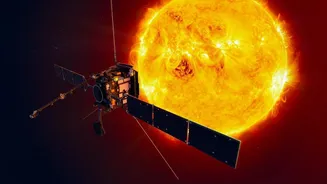
This is where NASA's new AI-powered approach comes in. Researchers have developed an advanced computer model named DAGGER (Deep Learning Geomagnetic Perturbation). This system was trained using deep learning on vast amounts of data from NASA's solar observation missions and ground-based magnetic field sensors. The AI learned to identify the complex links between the solar wind and the geomagnetic disturbances it causes. The result is a system that can predict the specific location and intensity of a geomagnetic storm on Earth with a 30-minute lead time, a task it can perform in less than a second.
A Game-Changer for India
For a nation like India, with its rapidly expanding digital infrastructure, ambitious space program, and sprawling power grid, this technological leap is critical. Early warnings are essential for protecting vital assets. With a 30-minute heads-up, utility companies can take steps to protect the electrical grid from damaging currents, and satellite operators, including those managing India's own NavIC navigation system, can put their spacecraft into a safe mode to ride out the storm. This moves space weather preparedness from a reactive to a proactive stance, safeguarding the technological backbone that millions rely on daily.
The Dawn of AI-Powered Space Science
DAGGER, along with other AI projects like the Surya model developed with IBM, represents a new frontier in heliophysics. These AI tools can sift through enormous datasets from spacecraft far faster and more efficiently than humans ever could, spotting subtle patterns that precede major solar events. This not only enhances our planetary defense but also deepens our fundamental understanding of the Sun itself. As NASA plans for future missions to the Moon and Mars, where astronauts will be far more exposed to solar radiation, these AI-driven forecasting tools will be an indispensable part of ensuring their safety.