



A Cosmic Sugar Cube
Imagine a giant cloud of gas and dust, thousands of light-years away, near the chaotic centre of our galaxy. It’s cold, dark, and not the first place you’d look for ingredients found in a kitchen pantry. Yet, using powerful radio telescopes, scientists
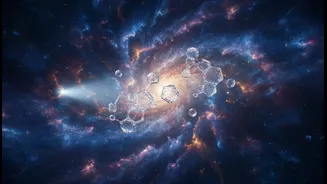
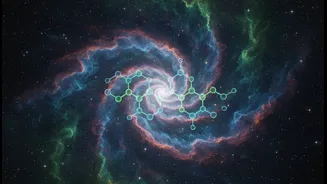
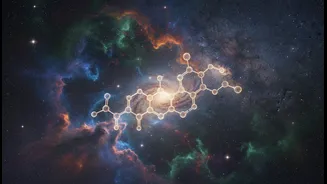
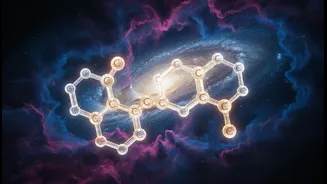
have detected the distinct chemical signature of erythrulose, a four-carbon sugar. On Earth, this same type of sugar is found in small amounts in raspberries. Its discovery in a molecular cloud known as G+0.693-0.027 is a landmark moment. While other organic molecules have been found in space before, and even sugars within meteorites that have landed on Earth, this is the first time a true sugar has been spotted floating freely in the interstellar medium—the vast emptiness between stars. This suggests that the universe has been stocking its pantry with life's essential ingredients long before any planets were around to use them.
More Than Just Sweetness
Finding sugar in space is not just a fun fact; it has profound implications for understanding the origins of life. Sugars are the backbone of biology. They form the structural framework for RNA and DNA, the molecules that carry the genetic instructions for all known life. The puzzle for scientists has long been how these crucial molecules first appeared on early Earth, as conditions on our young planet weren’t ideal for forming them from scratch. The discovery of erythrulose in space provides a compelling answer: maybe they didn't have to form on Earth at all. Instead, they could have formed in these vast stellar nurseries and then been delivered to young planets like ours. Researchers estimate that millions of tonnes of this sugar could have reached Earth during the Late Heavy Bombardment, a period billions of years ago when our planet was pelted by asteroids and comets.
The Stickiness Factor
So, how does a sugar molecule help build a planet? The process of planet formation begins with tiny grains of dust in a disc of material swirling around a young star. For these dust grains to grow into the building blocks of planets—known as planetesimals—they need to stick together. The problem is that bare, rocky silicate grains are not very sticky; they tend to bounce off each other or shatter upon collision. This is where organic molecules like erythrulose come in. When these sugars and other carbon-based compounds coat the silicate dust grains, they create a soft, sticky organic mantle. Think of it like a coating of caramel on a hard candy. This sticky layer dramatically increases the chances that when two grains collide, they will merge instead of break apart. This allows them to grow from microscopic specks into larger and larger clumps, eventually forming asteroid-sized bodies that serve as the seeds for future planets.
A New Recipe for Creation
The discovery also challenges what we thought we knew about chemistry in space. The prevailing theory was that complex molecules form by gradually adding one carbon atom at a time. If that were true, scientists would have expected to find lots of simpler three-carbon sugars alongside the four-carbon erythrulose. But they didn't. In fact, erythrulose was found to be at least eight times more abundant. This suggests a different chemical pathway may be at work, where erythrulose is formed by combining two smaller, two-carbon molecules that were also present in the cloud. This implies that the chemical factories in space might be more efficient at creating complex molecules than previously believed, using clever shortcuts to build the materials needed for planets and, just maybe, for life.