






Embrace the Darkness: Achieve Full Dark Adaptation
The single most important tool you have for stargazing is your own night vision. To see faint details, your eyes need to become fully dark-adapted, a process where your pupils dilate and your retinas switch from using colour-sensing cone cells to more
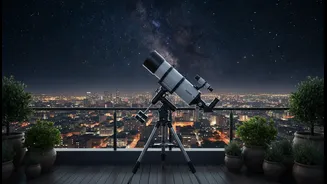
light-sensitive rod cells. This isn't a quick process. While initial adaptation happens in minutes, achieving peak sensitivity can take 30 to 40 minutes or even longer. To do this effectively, find the darkest spot available—a backyard, a park, or even a balcony shielded from direct streetlights. Before you go out, avoid bright screens and lights. If you absolutely need light, use a dim red flashlight, as red light is least likely to ruin your hard-won night vision. Even a quick glance at a bright white phone screen can reset the clock, forcing you to wait all over again.
Location, Location, Light Pollution
While you can't escape all city glow, your choice of observing spot matters immensely. Seek out locations that block direct sources of light. Setting up in the shadow of a building can make a significant difference. Haze and atmospheric pollution scatter city light, making the sky even brighter, so the clearest nights after a cold front passes are often your best bet. Another tip is to aim high. Observe planets when they are at their zenith—the highest point in the sky—rather than near the horizon. This means you're looking through the least amount of Earth's turbulent and light-polluted atmosphere, resulting in a clearer, more stable view. Also, avoid looking over rooftops or pavement where heat waves can cause the image in your telescope to shimmer.
The Art of Averted Vision
It may sound counterintuitive, but to see a faint object more clearly, you shouldn't look directly at it. This technique is called averted vision. Your eye's center (the fovea) is packed with cone cells, which are great for colour and detail in bright light but are not very sensitive in the dark. The more sensitive rod cells are concentrated in your peripheral vision. By looking slightly to the side of a planet, you allow its faint light to fall on these rod cells, making subtle details and colours pop into view. Practice scanning your eye around the target object without looking straight at it. With this method, observers report being able to see objects that are many times fainter than what's visible with direct vision.
Know Your Planetary Palette
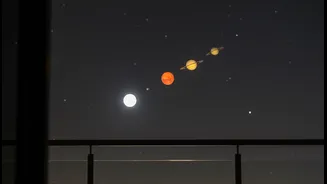
Not all planets are equally cooperative when it comes to showing their colours from the city. Planets are bright enough that they are generally unaffected by light pollution itself. Their brightness and colour depend on their size, distance, and what their surfaces or atmospheres are made of. Mars is well-known for its distinct reddish hue, which is often visible even to the naked eye. Through a telescope, Jupiter reveals its own palette, with ochre and cream-coloured cloud bands and the famous Great Red Spot. Saturn often presents a calmer, pale-yellow glow. These brighter planets are excellent targets for urban astronomers because their colours can cut through the skyglow. Venus is intensely bright but often appears as a brilliant white because its thick clouds reflect so much sunlight.
Consider Your Equipment
While planets are bright, the right equipment can enhance the view. A good telescope is key, but you don't necessarily need a massive one. Even a modest 6-inch telescope can reveal planetary details. More important than size is optical quality and proper setup. Make sure your telescope is properly collimated (aligned) to ensure a sharp image. For urban observers, light pollution filters can be a game-changer for viewing nebulae, but they are generally not necessary for planets because the planets themselves are so bright. However, some coloured planetary filters can increase contrast on specific features, like Mars's polar caps or Jupiter's cloud bands, making them easier to discern. Don't forget that a comfortable observing chair and a stable setup can make long, patient viewing sessions more enjoyable and productive.