






The Tiny Organisms Behind the Glow
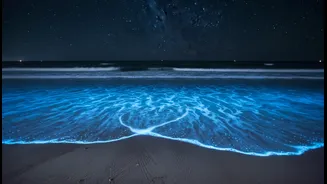
The spectacular light show is created by living organisms, a phenomenon known as bioluminescence. The primary culprits behind the glowing blue waves are microscopic, single-celled organisms called dinoflagellates. Specifically, a species named Noctiluca
scintillans, which translates to 'sea sparkle' or 'glowing bright by night', is often responsible for these displays. These tiny plankton drift in the ocean and, when found in high concentrations, can turn vast stretches of water into a natural light display.
The Chemistry of Light: Luciferin and Luciferase
The glow is the result of a chemical reaction happening inside each tiny organism. It involves two key components: a light-emitting molecule called luciferin and an enzyme called luciferase. When the dinoflagellates are disturbed — by a breaking wave, a passing boat, or even a fish swimming through the water — it triggers a stress reaction. This mechanical stimulation opens proton channels in the organism's cell membrane, causing a drop in pH inside specialised compartments called scintillons. This acidic environment activates the enzyme luciferase, which then oxidises the luciferin. The energy from this reaction is released not as heat, but as a flash of brilliant blue light. Each flash is incredibly brief, but when millions of organisms light up at once, the effect is a continuous, mesmerising glow.
A Defence Mechanism in Disguise
Scientists believe this light production is primarily a defence mechanism. The sudden flash of light can startle a potential predator, giving the dinoflagellate a moment to escape. Another theory, known as the 'burglar alarm' hypothesis, suggests the light attracts larger predators. For instance, if a small crustacean tries to eat a dinoflagellate, the resulting flash could attract a larger fish to eat the crustacean, thereby saving the plankton population. Essentially, the dinoflagellate lights up to call for help from a bigger bodyguard.
Where in India Can You Witness This?
India is blessed with several coastlines where this natural wonder can be observed. The phenomenon is often visible after the monsoon season, particularly on dark, moonless nights. Some well-known locations include Mattu Beach and Mulki in Karnataka, several beaches in Goa like Betalbatim and Palolem, and Havelock Island in the Andamans. Sporadic sightings have also been reported along the coasts of Maharashtra, including Aksa and Juhu beaches in Mumbai, as well as in Kerala and Tamil Nadu. Lakshadweep's Bangaram Island is another pristine spot renowned for its glowing waters.
A Beautiful Warning Sign?
While breathtakingly beautiful, these blooms, sometimes called 'red tides' (as they can appear reddish-brown during the day), are not always a good sign for the marine ecosystem. Noctiluca scintillans itself is not toxic, but massive blooms can have harmful effects. As these dense blooms die and decay, the decomposition process consumes large amounts of oxygen in the water, creating hypoxic or 'dead zones' where other marine life cannot survive. The blooms can also lead to high concentrations of ammonia, which is harmful to fish and other invertebrates. In some regions, like the Arabian Sea, the increasing frequency of these blooms has been linked to climate change and pollution, raising concerns about their long-term impact on marine food webs and fisheries.