



A Cosmic Seismograph
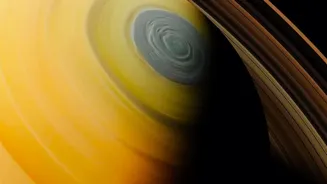
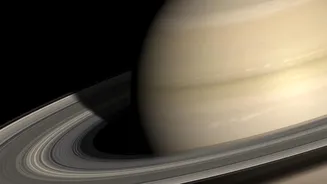
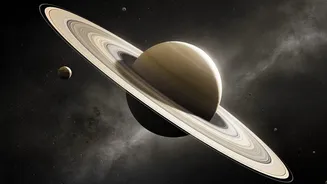
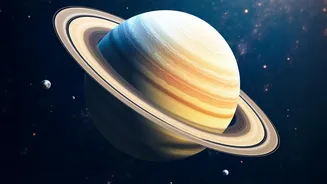
One of the most groundbreaking discoveries is that Saturn's rings act like a giant seismograph, recording the planet's inner turmoil. Much like earthquakes make the ground shake, Saturn's interior constantly pulsates and oscillates. These subtle vibrations
travel outwards and create ripples and waves in the rings. By studying the patterns in these waves, particularly in the C-ring, scientists can effectively 'listen' to the heart of the planet. Data from NASA's Cassini spacecraft, which studied these ring waves, has allowed researchers to map Saturn's interior in a way that was never before possible.
A 'Fuzzy' Core Revealed
Conventional models once suggested Saturn had a small, dense, rocky core, much like a pit in a peach. The ring seismology data, however, paints a much stranger picture. It reveals a huge, 'fuzzy' or diffuse core that is not a solid ball but a sloshing, soupy mixture of rock, ice, and metallic fluids that extends out to roughly 60% of the planet's radius. This core is estimated to contain the mass of 17 Earths. This discovery challenges long-held theories about how giant planets form, suggesting a much more gradual transition from core to the outer gas envelope than previously thought.
The Question of Age
A major debate among scientists is the age of the rings. Are they as old as Saturn itself, or are they a recent addition? One theory, based on how clean and bright the ice in the rings is, suggests they are relatively young—perhaps only 100 to 400 million years old. This would mean they may have formed when dinosaurs roamed the Earth, possibly from a shattered icy moon that strayed too close to the planet. However, other recent research proposes the rings might be as old as the solar system, arguing that a mysterious cleaning process could be keeping them looking perpetually fresh. The debate is a crucial one, as a young ring system points to a more dynamic and recently violent solar system than an ancient one.
A Laboratory for Planet Formation
Regardless of their age, the rings provide a perfect miniature laboratory for observing the processes that formed our solar system billions of years ago. The way tiny particles of ice and dust clump together to form small moonlets within the rings mirrors the process of accretion, where dust and gas in the early solar system coalesced to form planets. Watching the gravitational dance between the rings and Saturn’s many moons—how they carve out gaps and create waves—gives scientists a living model of the forces that shaped everything from Mercury to Neptune. In a sense, by studying Saturn's rings today, we are watching a replay of our own cosmic beginnings.