



The Universe’s Baby Pictures
For decades, the standard cosmological model, known as the Lambda-CDM model, has been our primary guide to the universe's evolution. This theory suggested a gradual, almost leisurely process of formation after the Big Bang. Following a period called the 'Cosmic
Dark Ages,' the first stars flickered into existence, living and dying within small, fragile gas clouds. Over hundreds of millions of years, gravity was expected to slowly pull these primordial ingredients together, first into small 'proto-galaxies' and then, through countless mergers and acquisitions, into the grand spiral and elliptical galaxies we see today. The prevailing wisdom was that the early universe was populated by small, messy, and disorganized collections of stars, not the mature structures that would come much later.
An Unexpected Cosmic Surprise
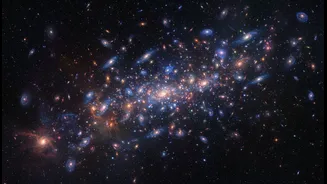
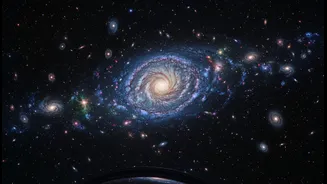
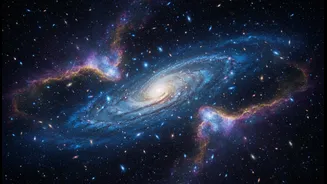
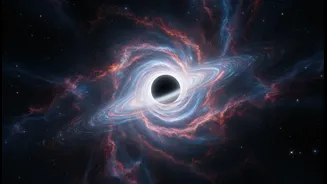
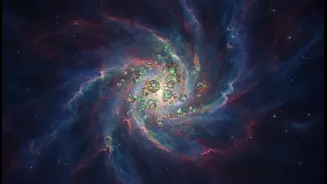
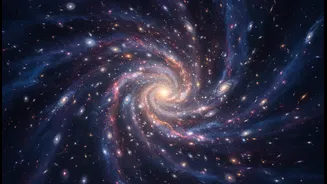
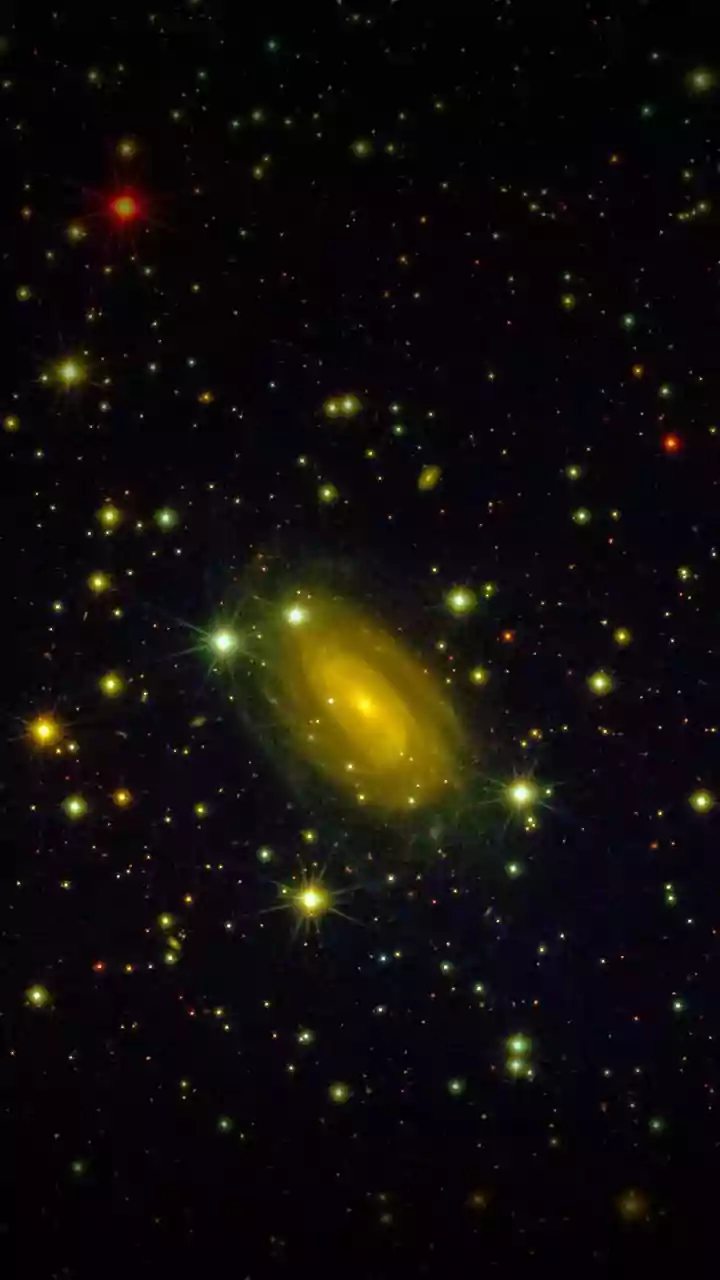
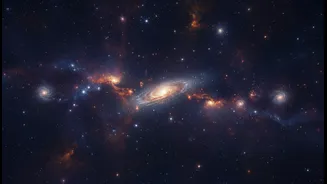
Recent observations, however, are painting a dramatically different picture. A new study, leveraging the unprecedented power of the James Webb Space Telescope (JWST), has identified a population of surprisingly massive and well-structured galaxies that existed just 300 to 500 million years after the Big Bang. This is a cosmic blink of an eye. These galaxies are far more mature than our theories predicted for that era. One study led by astronomers from Durham University found a galaxy more than nine billion years in the past that already had a complex, star-forming structure at its core, something previously believed to only exist in modern galaxies. Another recent discovery highlighted by the JWST involves “Little Red Dots,” compact and ancient galaxies that are far more numerous than expected, each likely hosting a rapidly growing supermassive black hole.
How Webb Is Rewriting History
So, how are we seeing these impossibly early galaxies? The answer lies with the James Webb Space Telescope. Unlike its predecessor, Hubble, which sees the universe primarily in visible and ultraviolet light, Webb is optimized to see in the infrared. As the universe expands, the light from the most distant objects gets stretched out into longer, redder wavelengths—a phenomenon called 'redshift'. By capturing this faint infrared light, Webb can effectively peer back in time to the era of the first stars and galaxies, a period known as the Cosmic Dawn. Its incredible sensitivity allows astronomers to not just detect these distant galaxies, but to analyze their chemical composition, size, and structure in stunning detail, providing the first 'direct' images of galaxy formation in action.
A New Chapter for Cosmology
These findings don't necessarily break the standard model of cosmology, but they do demand a major revision. The data suggests that the processes of galaxy and black hole formation might be far more efficient and rapid than previously imagined. Perhaps the seeds of galaxy formation, the tiny density fluctuations in the early universe, were more pronounced than we thought. Or maybe supermassive black holes formed first, acting as gravitational anchors that rapidly pulled in matter and accelerated the growth of their host galaxies. Astronomers are now scrambling to adjust their simulations and theories to account for this accelerated timeline. The 'chicken or the egg' problem of whether galaxies or their central black holes came first has become more intense than ever.