




The Technique: Transmission Spectroscopy
The primary method the JWST uses to analyze the air of these far-off worlds is called transmission spectroscopy. Imagine a planet passing in front of its star, like a tiny moth flying in front of a bright streetlight. As the planet transits, a small fraction
of the starlight filters through the planet's atmosphere. Scientists can then study this filtered light to see what the atmosphere is made of. The JWST is uniquely equipped for this, building on the legacy of predecessors like the Hubble and Spitzer space telescopes. Its ability to capture a wide range of infrared light, where molecular signatures are most prominent, allows for an unprecedented level of detail.
Catching a Chemical Fingerprint
Every chemical element and compound absorbs light at very specific wavelengths, creating a unique pattern, much like a barcode. Water vapor, for example, has a distinct signature in the infrared spectrum. To find it, astronomers first point the JWST at the star alone to get a clean reading of its light. Then, they wait for the exoplanet to transit and measure the starlight again. By subtracting the second measurement from the first, they can isolate the light that passed through the planet’s atmosphere and see which wavelengths were absorbed. These dips in the light spectrum reveal the chemical fingerprints of the molecules present, allowing scientists to confirm the presence of water.
Webb’s Powerful Eyes
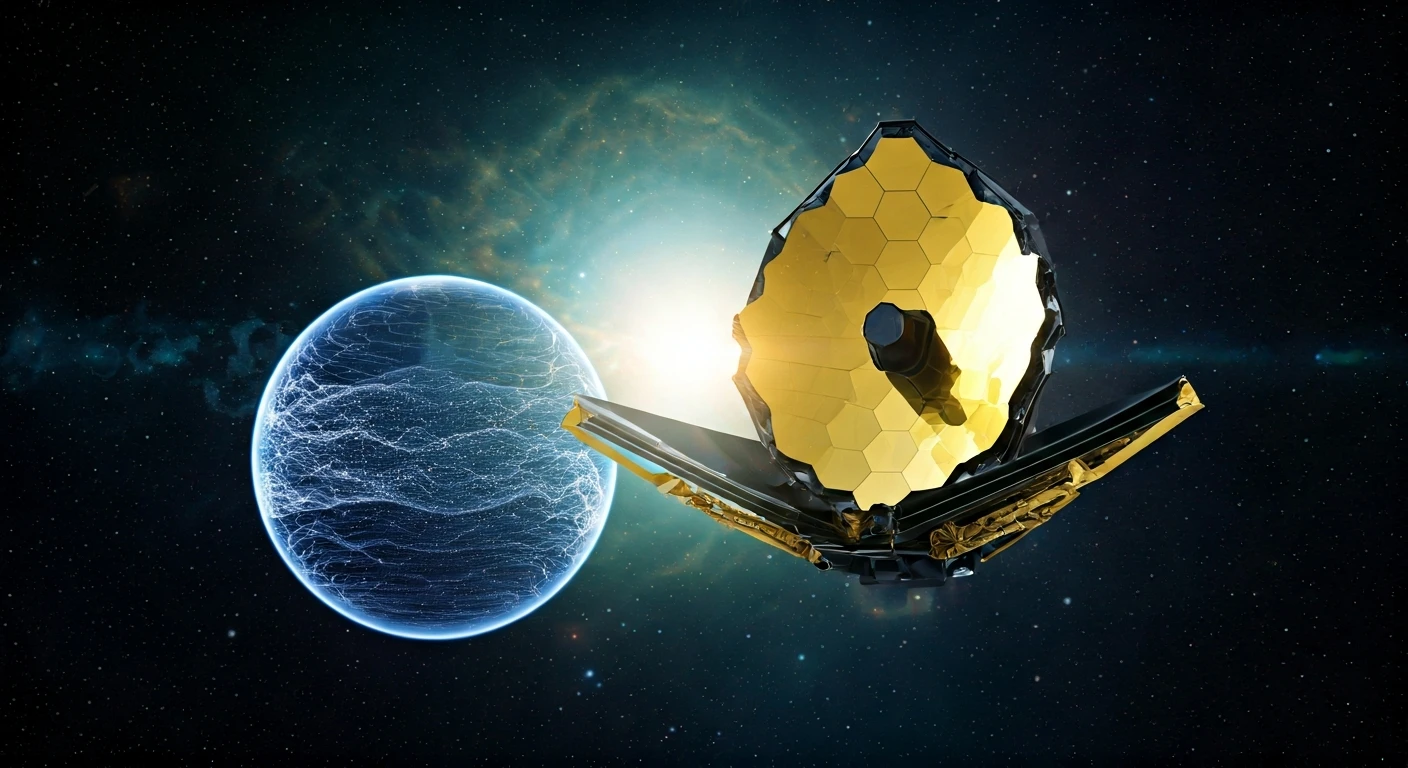
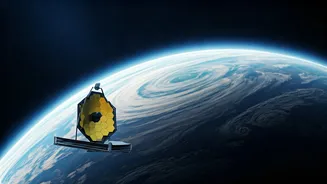
The JWST's success comes from its advanced instruments, particularly its spectrographs like the Near-Infrared Spectrograph (NIRSpec) and the Mid-Infrared Instrument (MIRI). These tools act like super-powered prisms, splitting the incoming starlight into its thousands of component colors, or wavelengths. Because the telescope is positioned far from Earth, it avoids the contaminating effects of our own atmosphere, ensuring the data is incredibly clean and precise. Its massive, gold-coated mirror is designed to efficiently collect faint infrared light from across the cosmos, making it sensitive enough to detect even subtle hints of water on planets hundreds or thousands of light-years away.
A Case Study: Worlds with Water
Since beginning operations, the JWST has successfully detected water in the atmospheres of several exoplanets. One of its first and most famous observations was of WASP-96 b, a hot gas giant 1,150 light-years away. The data revealed a clear and unambiguous signature of water vapor, along with evidence of clouds and haze that previous studies couldn't see. In another instance, studying the rocky exoplanet GJ 486 b, the telescope found hints of water vapor, a significant finding for a hot, rocky world. However, scientists remain cautious, as the signal could potentially come from cool spots on the host star itself rather than a planetary atmosphere. The telescope has also studied "sub-Neptunes" like TOI-421 b and even worlds that appear to be shrouded entirely in steam.
Why Finding Water Matters
Detecting water is a critical step in the search for life beyond Earth. While the presence of water vapor alone doesn't mean a planet is habitable—many of these worlds, like the scorching WASP-18b, are far too hot—it's an essential ingredient for life as we know it. By studying the composition of exoplanet atmospheres, scientists can learn more about how these worlds formed and evolved. Each detection of water, methane, carbon dioxide, or other molecules helps astronomers piece together the puzzle of planetary diversity in our galaxy. These findings are not just about individual planets; they help refine our understanding of how planetary systems, including our own, come to be.