
A Landmark Discovery in Deep Space
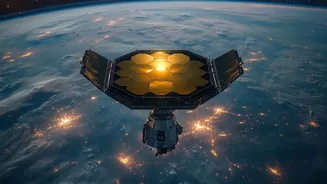
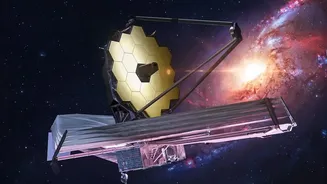
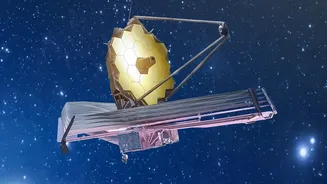
In a groundbreaking announcement that has electrified the astronomical community, scientists have confirmed the presence of water vapour on a planet outside our solar system. Using the unparalleled power of the James Webb Space Telescope (JWST), an international
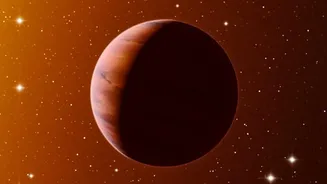
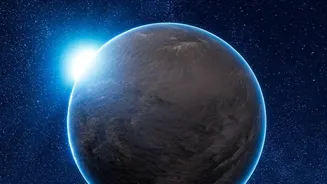
team of researchers analyzed the atmospheric composition of a super-Earth, a category of planet larger than our own but smaller than Neptune. This isn't just another dot in the sky; it’s a world hundreds of light-years away where we have now identified one of the most fundamental ingredients for life as we know it. The discovery demonstrates the incredible capability of the JWST, a joint project of NASA, the European Space Agency, and the Canadian Space Agency, to probe the secrets of alien worlds.
What Exactly Is a 'Super-Earth'?
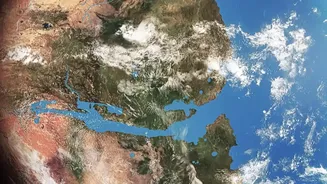
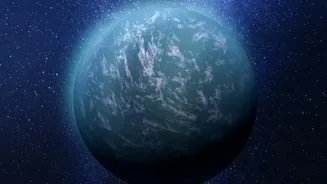
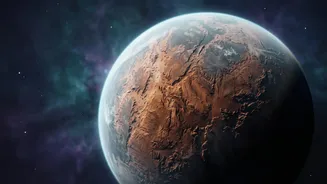
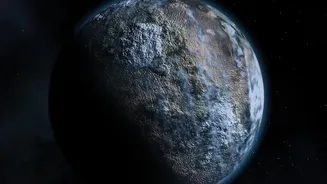
Our solar system is conspicuously missing planets in a very common size range seen throughout the galaxy: super-Earths. These are worlds with a mass higher than Earth's but substantially lower than that of our own ice giants, Uranus and Neptune. The term refers only to the planet's mass and size, not its surface conditions. They can be rocky worlds, water worlds, or even mini-Neptunes with thick gas envelopes. Because they are more massive than Earth, some super-Earths may have a better chance of retaining an atmosphere, which is a crucial prerequisite for surface liquid water and, potentially, life. This is why they are a prime target in the search for habitable exoplanets, and finding water on one is a significant milestone.
How the Telescope 'Sees' Water From Light-Years Away
Detecting specific molecules across such vast distances sounds like science fiction, but it's the reality of a technique called transmission spectroscopy. When a planet passes in front of its host star from our perspective—an event known as a transit—a tiny fraction of the starlight filters through the planet's atmosphere. Different molecules in that atmosphere absorb specific colours, or wavelengths, of light. The JWST's highly sensitive spectrographs can capture the starlight and analyze which colours are missing. These missing pieces create a unique chemical "barcode" or fingerprint. In this case, the telescope detected the unmistakable signature of water vapour, a testament to its incredible precision.
A Steamy World, Not an Ocean Paradise
While the discovery of water is thrilling, it's crucial to manage expectations. The presence of water vapour in an atmosphere does not automatically mean there are flowing rivers or deep oceans on the surface. Many of these super-Earths, including the one in this recent discovery, orbit very close to their host stars. The planet is likely scorching hot, possibly with surface temperatures reaching hundreds of degrees, similar to Venus. Under such conditions, the water would exist as a high-pressure, steamy vapor rather than liquid. So while this world is unlikely to be habitable in the way we understand it, the finding proves that water, a key building block, can and does exist in the atmospheres of rocky planets around other stars.
The Next Frontier in an Ancient Quest
This discovery is more than just a single data point; it's a doorway opening into a new era of exoplanet research. It confirms that we have the technology to not only find these distant worlds but to begin characterizing them in detail. Scientists will now use the JWST to study the atmospheres of many more rocky planets, searching for other key molecules like methane, carbon dioxide, and oxygen. The goal is to build a census of planetary atmospheres, understanding their diversity and looking for combinations of chemicals that could point towards biological activity. Each discovery helps refine theories about how planets form and evolve. This is a critical step on the long road to answering one of humanity's oldest questions: Are we alone?