




Imagine trying to hear a whisper from 13 billion years ago. That's the incredible challenge tackled by the Square Kilometre Array (SKA), a revolutionary global project designed to tune into the very first light in the universe.
The Universe’s Faintest Signal
The “early signals” the
SKA is hunting for are not from alien civilisations, but from a pivotal moment in cosmic history known as the Cosmic Dawn and the subsequent Epoch of Reionization. After the Big Bang, the universe was a dark, neutral place filled mostly with hydrogen gas. Over hundreds of millions of years, the first stars and galaxies began to form, and their intense light started to ionize the surrounding hydrogen, like turning on lights in a vast, dark room. This process left a faint, residual radio signature at a specific wavelength of 21 centimetres. This signal, stretched over billions of years by the expansion of the universe, is now incredibly faint and resides in the low-frequency radio band. Detecting it is one of the ultimate goals of modern astronomy, as it holds the secrets to how the first luminous structures in the cosmos were born.
A Telescope the Size of a Continent
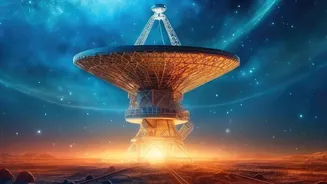
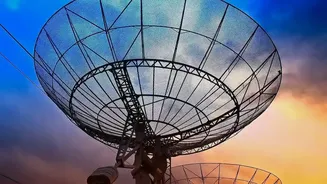
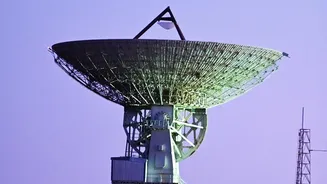
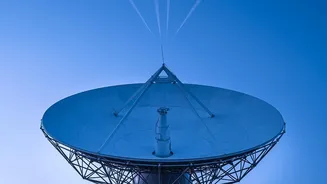
To capture such an elusive signal, you need a telescope of unprecedented scale and sensitivity. The SKA is not a single instrument but a massive array of thousands of antennas spread across two continents. The low-frequency component (SKA-Low), crucial for detecting the Cosmic Dawn, is located in the radio-quiet desert of Western Australia and consists of over 130,000 dipole antennas resembling Christmas trees. The mid-frequency component (SKA-Mid), which includes hundreds of classic dish antennas, is in South Africa's Karoo region. The name “Square Kilometre Array” comes from the ultimate goal of having a total signal collecting area of one million square metres. This vast distribution isn't just for show; it's the key to the SKA’s power. By using a technique called interferometry, signals from all these individual antennas can be combined. This allows the array to function as a single, virtual telescope with a diameter equal to the largest distance between the antennas—spanning thousands of kilometres. This provides the extraordinary resolution needed to map the sky in stunning detail, far exceeding the capabilities of existing telescopes.
How to 'Listen' to the Cosmos
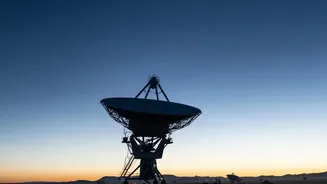
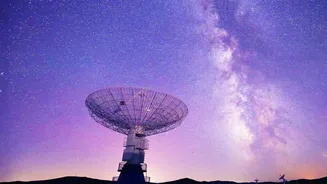
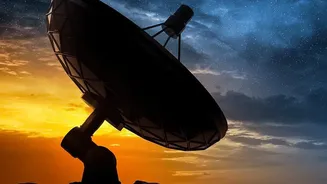
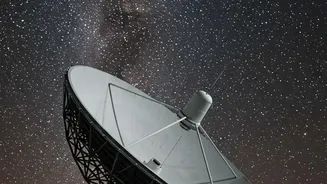
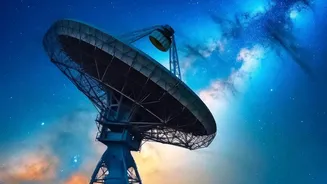
Unlike an optical telescope that collects light our eyes can see, a radio telescope's dish acts like a giant bucket, collecting faint radio waves from space. These waves are funnelled to a receiver, which converts them into electrical signals. For the SKA, this process is magnified thousands of times over. Each antenna in the array captures its piece of the cosmic puzzle. The real magic happens in the processing. The signals from each pair of antennas, or 'baseline', are compared by a powerful supercomputer called a correlator. By analysing the tiny differences in the arrival time of the same radio wave at different antennas, astronomers can reconstruct an incredibly detailed picture of the source. For SKA-Low, this is even more advanced; the antennas don't move but instead use a process called 'beamforming' to digitally point and create multiple beams at once, allowing it to survey huge patches of the sky with incredible speed.
A Tsunami of Data
The sheer amount of information the SKA will gather is staggering. The data flowing from the antennas will generate more traffic than the entire internet. This requires some of the fastest supercomputers on the planet to process, filter, and store the information. The challenge is immense, as the faint 21-cm signal is buried under cosmic noise from our own galaxy and other sources that is thousands of times stronger. Sophisticated algorithms, including machine learning, are being developed to sift through this noise and isolate the precious whispers from the dawn of time. This technological push is not just for astronomy; it drives innovation in high-performance computing, data management, and signal processing that will have benefits far beyond science.