







The Seven Sisters in the Sky
The Pleiades, also known as Messier 45, is one of the most famous star clusters in the night sky. Often called the 'Seven Sisters', this grouping of bright, hot blue stars is located in the constellation of Taurus. While the name suggests seven stars,
the cluster actually contains over a thousand, all born from the same cosmic cloud of gas and dust about 100 million years ago. To the naked eye, it typically appears as a small, shimmering dipper-shaped collection of six or seven stars. In India, the Pleiades hold deep cultural significance as the Krittika nakshatra. In Hindu mythology, the Krittika are the six celestial mothers who nurtured Lord Kartikeya, the god of war. This 'Star of Fire' is associated with sharpness, purification, and divine energy, ruled by the Sun and the deity Agni, the God of Fire.
What to Expect on October 27-28
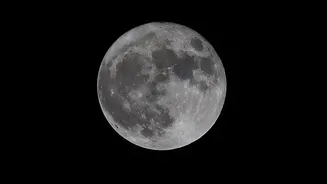
The upcoming event is a conjunction, which happens when two celestial objects appear close to each other in the sky from our perspective on Earth. On the nights of October 27 and into the morning of October 28, the Moon will glide past the Pleiades cluster. According to NASA, this provides a wonderful opportunity for skywatchers to easily locate the famous cluster using the Moon as a bright guide. The Moon, which will be in its waxing gibbous phase, will be quite bright. While its glare might make it slightly challenging to see the fainter stars of the cluster, the brightest members of the Seven Sisters should still be visible nearby. This celestial pairing offers a beautiful study in contrast—our bright, rocky neighbour against a backdrop of distant, brilliant blue suns located about 440 light-years away.
How to Watch from India
This event will be easily visible from across India, provided the skies are clear. To see it, you don't need any special equipment, though binoculars or a small telescope will dramatically enhance the view. On the evenings of October 27 and 28, look towards the eastern sky after nightfall. You will see the bright Moon rising, and nestled close to it will be the compact, fuzzy patch of stars that is the Pleiades. As the night progresses, the pair will climb higher in the sky, making them easier to observe. To find them, you can also locate the constellation of Orion and its famous three-star belt. Follow the line of the belt upwards until you find the bright, reddish star Aldebaran, and continuing that line will lead you right to the Pleiades.
Tips for the Best Viewing Experience
For the best possible view, follow a few simple tips recommended by astronomers. First, try to find a location away from bright city lights. Light pollution can wash out the fainter stars, and finding a darker spot will make a huge difference. Second, give your eyes time to adapt to the darkness—it can take about 20-30 minutes for your vision to fully adjust, allowing you to see more celestial detail. While the cluster is visible to the naked eye, using a pair of binoculars is highly recommended. Binoculars will resolve the fuzzy patch into a stunning collection of individual stars and may even reveal some of the faint nebulosity that surrounds the cluster, which is gas and dust left over from its formation. Finally, be sure to check your local weather forecast for clear skies before heading out.