


Cosmic Shadow Play
The primary technique scientists use is called transmission spectroscopy, and it's a bit like watching a cosmic shadow play. To use it, astronomers need a bit of luck: they need a planet that passes directly in front of its host star from our point of view.
This event is called a transit. As the planet crosses the star, it blocks a tiny fraction of the starlight, causing a minuscule dip in the star's brightness. But the real magic happens at the very edge of the planet. A sliver of starlight filters through the planet’s atmosphere, which acts like a giant chemical filter. Different gases in the atmosphere absorb very specific colours, or wavelengths, of light.
Reading the Rainbow
By capturing the light from the star before, during, and after the transit, a powerful space telescope can see precisely which colours are missing from the starlight that passed through the atmosphere. Each gas—be it water vapour, carbon dioxide, or methane—has a unique absorption pattern, like a chemical fingerprint or a barcode. If the telescope sees the specific barcode for methane missing from the starlight's rainbow, it is a clear sign that methane exists on that distant world. For years, this was theoretically possible but practically very difficult, as the signals are incredibly faint and many key gases, including methane, absorb light in the infrared spectrum, which is hard to observe from Earth.
A New Eye on the Cosmos
This is where the James Webb Space Telescope (JWST) has been a complete game-changer. Launched with unprecedented sensitivity and powerful infrared instruments, JWST is perfectly designed for this kind of detective work. Before Webb, methane was surprisingly elusive in exoplanet atmospheres, even on worlds where scientists expected to find it. But since it began its science operations, JWST has started finding it. The telescope is so powerful that it can achieve in one or two transits what might have taken the Hubble Space Telescope years of observation to accomplish, and with far greater clarity. This has opened the door to studying a whole class of planets called Warm Neptunes.
The Curious Case of Warm Neptunes
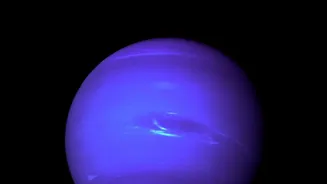
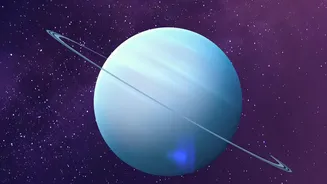
Warm Neptunes are planets similar in size to our own Neptune or Uranus, but they orbit much closer to their stars. They are incredibly common in the galaxy, yet our own solar system curiously lacks one, making them objects of intense scientific interest. Using JWST, astronomers have recently made stunning discoveries on these worlds. On a Warm Neptune named WASP-107b, they not only detected methane, but found its concentration was lower than predicted. This wasn't a failure, but a clue, suggesting the planet's atmosphere is incredibly turbulent, with powerful vertical winds dredging up gases from the hotter interior and altering its chemical balance.
Why Methane Matters So Much
The search for methane isn't just an academic exercise. While its presence on a gas giant like WASP-107b points to fascinating atmospheric physics, finding it elsewhere has different implications. On Earth, while some methane comes from geology, a significant amount is produced by life. This makes it a potential 'biosignature.' JWST also studied a planet called K2-18b, a world larger than Earth that sits in its star's habitable zone. There, it found both methane and carbon dioxide. The combination of these gases, and the lack of ammonia, supports the theory that K2-18b could be a 'Hycean' world—a planet with a deep liquid water ocean under a hydrogen-rich atmosphere. While this is not proof of life, finding the right ingredients in the right place is a monumental step in the search.