



The Hunt for Life's Building Blocks
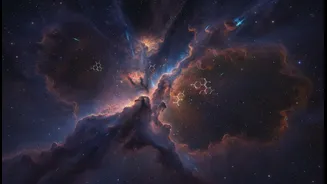
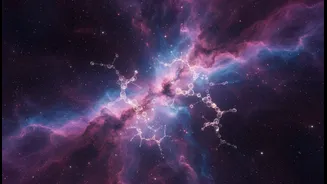
For decades, scientists have known that space is not just an empty void. It is a vast chemical factory. Telescopes have detected a surprising variety of molecules, including complex organic compounds, floating in the enormous clouds of gas and dust between
stars. Even more compellingly, meteorites that have fallen to Earth have been found to contain amino acids, the fundamental components of proteins. This suggests a tantalizing possibility: that the raw ingredients for life were not originally made on Earth, but were delivered here from space billions of years ago by comets and asteroids. This theory, known as panspermia, has driven researchers to ask a critical question: how did these complex molecules form in the first place, in the cold, harsh environment of interstellar space?
Bringing the Stars Down to Earth
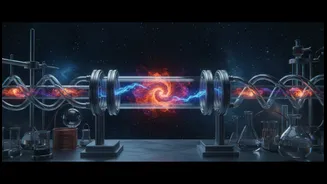
To answer that, scientists can’t simply wait for more cosmic deliveries. Instead, they bring the cosmos into the laboratory. In facilities around the world, researchers in the field of laboratory astrophysics create what can be described as “stars in a jar” or, more accurately, deep space in a glass tube. These experiments use state-of-the-art cryovacuum systems—chambers from which almost all air is removed to create an ultra-high vacuum, and which are then cooled to temperatures as low as 10 Kelvin (-263°C), mimicking the frigid conditions of a dense molecular cloud. These chambers are our best attempt at recreating a small, controlled slice of the universe to watch prebiotic chemistry unfold in real-time.
A Recipe for a Primordial Soup
The process is like baking a cosmic cake. Scientists begin by spraying a mixture of simple gases—such as water, carbon dioxide, ammonia, and methane—onto a substrate cooled to near absolute zero. These gases are chosen because they are known to be abundant in interstellar ice clouds. As they hit the cold surface, they freeze into a thin layer of ice, creating an “interstellar ice analog.” Then comes the crucial step: this ice is blasted with energy, typically in the form of ultraviolet (UV) photons from powerful lamps or high-energy particles from accelerators. This simulates the constant bombardment of radiation that interstellar ices would experience from nearby stars or cosmic rays over millions of years. The goal is to see if this energy can break apart the simple molecules and encourage them to recombine into something more complex.
From Simple Ices to Complex Molecules
The results have been astonishing. When the ice is gently warmed, simulating the heat from a newly forming star, a rich, gooey organic residue is often left behind. Analysis of this residue has revealed the spontaneous formation of a wide array of complex organic molecules. Researchers at the University of Hawaiʻi at Mānoa have successfully created a full set of carboxylic acids, which are critical for metabolic processes in all known life. Other experiments have produced amino acids, the building blocks of proteins, and even uracil, a component of RNA. In a fascinating discovery, some studies have shown that when irradiated, the ice doesn't just stay solid; it can enter a liquid-like state at incredibly low temperatures, which could dramatically speed up the formation of these prebiotic molecules by allowing them to move around and react more freely.
Connecting the Lab to the Cosmos
These laboratory findings are not just theoretical exercises. They provide a vital chemical fingerprint that astronomers can use to search for these molecules in space. When scientists create a molecule like methanetetrol—a highly unstable compound considered a “seed of life”—in the lab, they can measure its unique spectral signature. Astronomers can then point powerful instruments, like the James Webb Space Telescope (JWST), toward distant star-forming regions and look for that exact same signature. This powerful synergy between lab work and observational astronomy allows scientists to confirm that the chemistry happening in their glass tubes is the same chemistry happening light-years away. It validates the idea that the universe is naturally capable of producing the ingredients necessary for life.