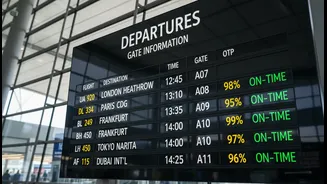









Understanding On-Time Performance
On-Time Performance, or OTP, is the key metric that measures the punctuality of an airline or airport. A flight is considered 'on-time' if it departs or arrives within 15 minutes of its scheduled time. In India, the Directorate General of Civil Aviation
(DGCA) is the official body that tracks and publishes this data monthly for major domestic airlines and airports. This transparency empowers passengers, moving punctuality from a vague promise to a measurable factor. For years, flyers chose airlines based on price or schedule alone, but with consistent delays impacting everything from business meetings to family holidays, OTP is becoming a crucial part of the decision-making process for savvy travellers.
The Airline Punctuality League Table
The DGCA's data reveals a clear hierarchy among Indian carriers. According to the latest reports from May 2026, IndiGo leads the pack with an OTP of 82.8% at major airports. Following closely is the newer entrant, Akasa Air, at 78.3%. The Air India Group registered a combined OTP of 74.5%. However, a striking development in June 2026 saw Air India significantly improve, ranking as the world's 4th most punctual airline with an on-time arrival rate of 86.85%, according to analytics firm Cirium. This highlights a dynamic and competitive environment where airline efforts to improve operational efficiency can yield tangible results for passengers. At the other end of the spectrum, SpiceJet's performance in May was notably poor, with an OTP of just 26.5%, indicating that a majority of its flights were delayed.
Which Airports Keep You on Schedule?
An airline's performance is only part of the story; airport efficiency is just as critical. The May 2026 DGCA data shows that Chennai International Airport (MAA) was India's most punctual major airport, with an impressive 92.2% of flights operating on time. This was significantly ahead of other major hubs. Kolkata (CCU) came in second at 84.7%, followed by Hyderabad (HYD) at 84.4% and Bengaluru (BLR) at 82.3%. In contrast, some of the country's busiest airports lagged behind, with Delhi (DEL) recording an OTP of 72.6% and Mumbai (BOM) at 70.5%. The data suggests that operational efficiency, air traffic management, and ground handling coordination at airports like Chennai are providing a smoother experience for travellers.
How to Use This Data for Your Travels
For the everyday flyer, this data is more than just numbers; it's a practical tool. When booking a flight, especially for time-sensitive travel, checking an airline's recent OTP can be as important as comparing fares. If you have a tight connection or an important meeting, opting for an airline that consistently ranks higher in punctuality, like IndiGo or Akasa Air, might be worth a slightly higher ticket price. Similarly, if your travel plans are flexible, you might find better deals on airlines with lower OTP scores. The DGCA's monthly reports are publicly available, and many travel analysis websites now incorporate this data into their insights. This allows you to weigh the risk of a delay against potential cost savings, putting you in control of your journey.
Why Punctuality Is No Longer Just a Perk
As India's aviation market continues to grow, with domestic airlines carrying nearly 730 lakh passengers in the first five months of 2026, the ripple effects of a single delay are magnified. Delays don't just inconvenience passengers; they have a real economic cost. For airlines, they lead to increased operational expenses, while for passengers, they can mean missed connections, lost business opportunities, or ruined holidays. The financial impact is substantial; in May 2026 alone, Indian airlines spent over ₹4.24 crore on facilitation for more than 1.77 lakh passengers affected by delays. This growing awareness, coupled with the availability of transparent data, is shifting passenger expectations. Punctuality is no longer seen as a luxury but as a fundamental component of reliable service.