






The Universe’s Ultimate Lighthouses
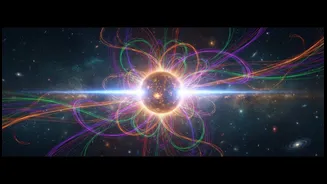
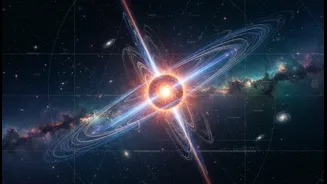
Imagine a star so massive it collapses under its own weight, crushing its atoms into an object so dense a single spoonful would weigh billions of tons. This is a neutron star. Some of these stellar remnants spin hundreds of times per second, and as they
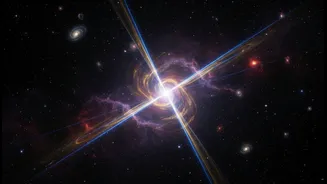
do, their intense magnetic fields channel beams of radiation out from their poles. If one of these beams sweeps past Earth, we see a regular pulse of energy. This is a pulsar. For decades, scientists have used the clock-like precision of these pulses for everything from testing theories of gravity to creating a celestial map for the Voyager spacecraft. But understanding the pulsars themselves, particularly their surfaces and magnetic fields, has been a major challenge.
The Puzzle of Extreme Magnetic Fields
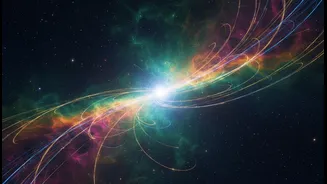
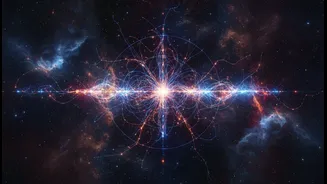
Magnetic fields are everywhere in the cosmos, shaping galaxies and guiding the birth of stars. But the fields around pulsars are on another level entirely. They are trillions of times stronger than Earth’s, and in some special cases, a thousand times stronger still. These objects, known as magnetars, possess the most powerful magnetic fields known in the universe. Such extreme magnetism creates conditions that cannot be replicated in any laboratory on Earth. It warps the very fabric of space and can cause starquakes on the neutron star's crust, releasing enormous bursts of energy. Studying these fields is crucial for understanding the fundamental laws of physics under the most extreme conditions imaginable, but their complexity has long been a mystery. The simple, two-pole 'bar magnet' model that scientists used for years simply wasn't adding up.
Enter NICER: NASA’s Pulsar Detective
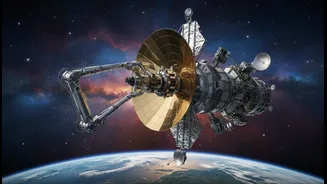
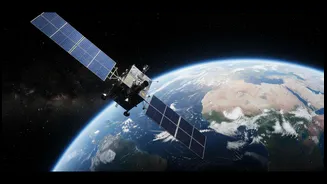
Mounted on the International Space Station, NASA’s Neutron star Interior Composition Explorer, or NICER, is a high-tech X-ray telescope with a singular mission: to study these dense, spinning objects. Launched in 2017, NICER isn't like a normal telescope that takes pictures. Instead, it functions as a super-precise timing instrument. It records the arrival time of each individual X-ray photon from a pulsar with a precision of under 300 nanoseconds. By collecting millions of these data points, scientists can build an incredibly detailed picture of the X-rays coming from the pulsar. The subtle variations in the timing and energy of these photons hold the secrets to the pulsar's surface and the structure of its magnetic field.
Mapping a Star’s Fiery Surface
So, how does timing X-rays create a map? A pulsar's powerful magnetic field rips charged particles from its surface and slams them back down, creating 'hot spots' that glow brightly in X-rays. As the pulsar spins, these spots rotate in and out of our view, causing the X-ray signal to pulse. By meticulously analyzing how the light from these spots brightens and dims, scientists using NICER can reconstruct their shape and location. The process is complicated by the fact that the pulsar’s immense gravity bends spacetime, allowing scientists to see parts of the far side of the star. The first maps created with NICER, for a pulsar named J0030, were astonishing. Instead of two neat hot spots at the magnetic poles as long predicted, they revealed a complex arrangement of multiple spots, all located in the star's southern hemisphere. This discovery proved that pulsar magnetic fields are far more complex than the simple dipole model.
Why This Cosmic Cartography Matters
Mapping pulsars with NICER isn't just about creating pretty pictures of distant objects. It represents a fundamental shift in how we can study extreme physics. By providing the first real look at the structure of these powerful magnetic fields, the maps allow scientists to test and refine their theories about how matter behaves at unimaginable densities and pressures. It helps explain the origins of mysterious cosmic phenomena like Fast Radio Bursts, some of which are thought to originate from magnetars. Furthermore, these precise maps serve as a foundation for future technologies. One of NICER's secondary missions, SEXTANT, has already demonstrated that pulsars can be used as a kind of celestial GPS for deep-space navigation, providing a fixed reference point for spacecraft exploring the far reaches of our solar system.