




First, Let’s Define Our Terms
Before we travel to Venus, let’s get our bearings on Earth. We have two fundamental units of time based on planetary motion. A ‘day’ is the time it takes for a planet to complete one full rotation on its axis. A ‘year’ is the time it takes for a planet to complete one full orbit
around its star. On Earth, this is simple: a day is 24 hours, and a year is about 365.25 of those days. We intuitively understand that many days fit inside one year. This basic rhythm governs our lives, our seasons, and our calendars. It feels like a universal constant, but as we’re about to see, the universe loves to break its own rules.
Welcome to Venus, The Rule-Breaker
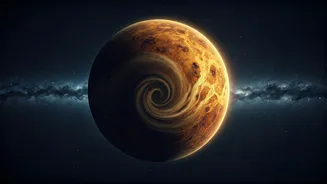
Now, let’s look at Venus. If we apply our Earth-based definitions, things get strange very quickly. A Venusian year—the time it takes for Venus to orbit the Sun—is approximately 225 Earth days. So far, so good. But a Venusian day—the time it takes for the planet to spin once on its axis—is a stunning 243 Earth days. Take a moment to absorb that: its day is longer than its year. If you were standing on Venus, the planet would complete its entire journey around the Sun before it finished a single rotation. It’s a concept so alien that it’s hard to picture, but it’s the result of some truly unique planetary dynamics.
The Secret Is in Its Spin
So, what causes this bizarre situation? The primary reason is Venus’s incredibly slow and backward rotation. Most planets in our solar system, including Earth, rotate on their axis in a counter-clockwise direction (prograde motion). Venus is the odd one out; it spins clockwise (retrograde motion). Not only does it spin backwards, but it does so with agonising slowness. While Earth zips through a rotation in 24 hours, Venus takes 243 Earth days to do the same. This combination of a slow speed and backward direction is the key to understanding why its day outlasts its year.
Sunrise to Sunrise: The Solar Day
Here’s where it gets even weirder. The 243-day figure is for a ‘sidereal day’ (one full 360-degree rotation). But what about a ‘solar day’—the time from one sunrise to the next? Because Venus is orbiting the Sun in one direction while slowly rotating in the opposite direction, the two motions work against each other. This means an observer on the surface would see the Sun rise and set, but the time between sunrises would be about 117 Earth days. So, while its rotational day is 243 Earth days long, you’d experience roughly two ‘days’ (in the sunrise-to-sunrise sense) in every one Venusian year. Confusing? Absolutely. Fascinating? Without a doubt.
Why Is Venus So Peculiar?
Scientists don't have a definitive answer for why Venus spins this way, but there are some leading theories. The most popular hypothesis suggests that Venus had a more ‘normal’ rotation early in its history. However, a massive impact event—a collision with a planet-sized object billions of years ago—could have been powerful enough to not just tilt its axis, but to completely reverse its spin. Another theory posits that the thick, heavy atmosphere of Venus, combined with gravitational tides from the Sun and other planets, could have gradually slowed its rotation and eventually flipped it over. Whatever the cause, it has left Venus as one of the most unusual worlds in our cosmic neighbourhood.