


The Invisible Threat of Space Radiation
Beyond Earth's protective magnetic field and atmosphere, space is saturated with radiation. This isn't a single problem, but two: a constant shower of high-energy galactic cosmic rays (GCRs) from deep space, and unpredictable solar particle events (SPEs)
from our own sun. Long-term exposure to this environment can lead to significant health risks for astronauts, including an increased lifetime risk of cancer, cardiovascular disease, and damage to the central nervous system. Unlike the lead shields used for X-rays on Earth, blocking these high-energy particles in space is far more complex. Heavy materials can actually make the problem worse by creating secondary radiation when struck.
Building a Cosmic Shield
The solution, designers have found, lies in materials rich in hydrogen. Polyethylene, a common plastic, is a key material being used and tested because its high hydrogen content is effective at stopping energetic particles without creating a spray of secondary neutrons. Some crew quarters on the International Space Station (ISS) already use polyethylene for added protection. Water is another excellent shielding material for the same reason, and designers are exploring how to integrate a habitat's water supply into its walls for dual-purpose protection. Companies are also developing advanced composites, such as carbon fiber-reinforced polymers and materials infused with boron nitride, which promise high strength and effective shielding at a lower weight. For intense solar storms, habitats will feature a heavily shielded 'storm shelter' area where the crew can wait out the event. Inflatable habitats, like Sierra Space's LIFE module, use multiple layers of high-strength fabrics that protect against radiation and debris.
The Weightless Toll on the Body
Living without gravity, or in microgravity, sounds like fun, but it takes a serious toll on the human body. Without the constant pull of gravity, astronauts experience significant muscle atrophy and bone density loss, sometimes losing up to 20% of muscle mass in under two weeks. The cardiovascular system also deconditions, as the heart doesn't have to work as hard to pump blood. Fluids shift upwards in the body, leading to a puffy face, nasal congestion, and potential vision problems known as Spaceflight-Associated Neuro-ocular Syndrome (SANS). These physiological changes can impair an astronaut's ability to perform tasks and pose risks upon their return to a gravity environment.
Designing a Home for Zero-G
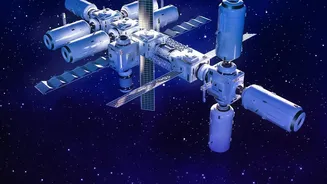
To combat these effects, private habitats are being designed with human physiology at their core. Intense, daily exercise is the primary countermeasure. Commercial stations will be equipped with advanced resistive exercise devices, treadmills, and cycle ergometers to help astronauts maintain muscle and bone mass. But design goes beyond the gym. Axiom Space, for its planned station, hired renowned designer Philippe Starck, who envisioned a comfortable, padded "egg"-like interior. The walls are soft, with handholds for easy movement and nano-LEDs that change color to support circadian rhythms. Companies are also considering the layout to make daily life functional. Since there's no up or down, surfaces can be used for multiple purposes, and interior design must accommodate a 360-degree freedom of movement. For Orbital Reef, the station being developed by Blue Origin and Sierra Space, expandable LIFE habitats will create large, three-story volumes for living, working, and even growing fresh produce in an 'Astro Garden'.