





What Exactly Is an Inflatable Heat Shield?
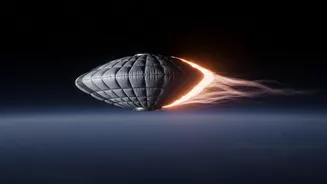
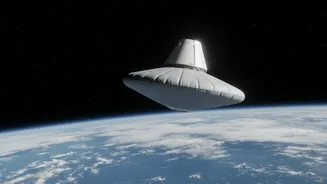
Forget party balloons; this is not your average inflatable. An inflatable heat shield, technically known as a Hypersonic Inflatable Aerodynamic Decelerator (HIAD), is a collapsible, lightweight system designed to be packed into a small volume for launch.
Just before a spacecraft enters a planet's atmosphere, the system inflates, expanding into a large, rigid, mushroom-like shape. This structure is made of advanced materials, including concentric rings woven from synthetic polymers that are, by weight, ten times stronger than steel. These rings provide the structural stability needed to withstand the immense forces of re-entry. The entire assembly is then covered by a flexible thermal protection system made of high-temperature fabrics and insulation capable of surviving temperatures hotter than lava.
How Does It Work?
The primary job of any heat shield is to manage the extreme heat and deceleration of atmospheric entry. A spacecraft can hit the top of the atmosphere at speeds exceeding 28,000 kilometres per hour. An inflatable heat shield works by creating a huge amount of drag. When deployed, its large surface area slams into the upper atmosphere, using air molecules as a brake to rapidly slow the vehicle down at a much higher altitude where the air is thinner and cooler. This process significantly reduces the peak heating the spacecraft experiences. The successful NASA LOFTID (Low-Earth Orbit Flight Test of an Inflatable Decelerator) mission in 2022 was a crucial demonstration. The 6-meter-wide shield inflated in orbit, survived re-entry speeds of Mach 29, and splashed down safely in the Pacific Ocean, proving the technology is ready for future missions.
The Big Advantage: Overcoming Rocket Size Limits
The single biggest advantage of inflatable heat shields is their ability to overcome the limitations of a rocket's nose cone, or fairing. Traditional rigid heat shields can only be as wide as the rocket that carries them, which is typically around 5 meters in diameter. This physical constraint limits the mass of payloads we can land on planets like Mars. A heavier payload requires a larger heat shield to create enough drag to slow it down, especially in the thin Martian atmosphere. Since an inflatable shield launches in a compact state, it can be deployed to a diameter much larger than the rocket it flew on. This technology opens the door to landing heavier cargo, including the habitats, supplies, and ascent vehicles needed for a future human mission to Mars.
More Than Just Size: Other Key Benefits
Beyond enabling larger payloads, inflatable systems offer other significant benefits. They are inherently lightweight compared to their rigid counterparts, which is a massive advantage in the world of aerospace where every kilogram counts. This reduction in mass can translate into lower launch costs or allow for more scientific instruments to be packed into a mission. Furthermore, the technology is scalable. The same basic design of inflatable rings and thermal blankets can be adjusted for a wide range of mission profiles, from returning manufactured goods from low-Earth orbit to sending robotic probes to Venus or Saturn's moon, Titan. Some companies, like United Launch Alliance, are even exploring using this tech to recover and reuse valuable rocket engines, which could further drive down the cost of accessing space.
The Future: A Gateway to New Worlds
With successful demonstrations like LOFTID, inflatable heat shield technology is now considered a critical enabler for the next generation of space exploration. It is a key component being considered for the ambitious Mars Sample Return mission, which will require a vehicle capable of bringing Martian rock and soil samples back to Earth. The ability to land at higher-altitude sites on Mars, which are currently inaccessible with current technology, would also open up new and scientifically interesting regions for exploration. European agencies are also actively developing their own inflatable systems, with projects like ICARUS aiming to demonstrate the technology for recovering rocket stages. This innovation isn't just an engineering curiosity; it's a foundational piece of technology paving the way for more complex and ambitious scientific discovery across our solar system.