



Why Sitting Causes Tight Hips
When you sit for hours, your hips are held in a flexed position. This can cause the muscles at the front of your hip, known as the hip flexors, to become short and tight. This group of muscles, which includes the psoas and iliacus, connects your thigh
bone to your pelvis and lower back. Over time, this chronic shortening can pull your pelvis forward, potentially leading to lower back discomfort and reduced mobility. It makes it harder for your pelvis to rotate properly, which can create a chain reaction of stiffness and pain. The goal of stretching is to lengthen these overworked muscles and restore balance to your hips.
1. Kneeling Hip Flexor Stretch
This is a fundamental stretch for targeting the front of the hip. Start by kneeling on a soft surface like a mat or carpet. Bring your right foot forward, planting it flat on the floor so your knee and ankle are aligned at a 90-degree angle. Your left knee should remain on the floor directly under your hip. Keeping your back straight and core engaged, gently press your hips forward until you feel a comfortable stretch in the front of your left hip and thigh. Avoid arching your back; the movement should come from the hips. For a deeper stretch, you can raise your left arm overhead. Hold for 20-30 seconds, then switch sides.
2. Seated Figure-Four Stretch
This stretch, also known as the piriformis stretch, is excellent for opening the outer hip and can be done discreetly at your desk. Sit tall at the edge of your chair with your feet flat on the floor. Cross your right ankle over your left thigh, just above the knee, creating a 'figure four' shape. Keep your right foot flexed to protect your knee. Now, maintaining a straight back, gently hinge forward from your hips until you feel a stretch in your right glute and hip. You can apply gentle pressure on your right knee with your hand to deepen the stretch. Hold for 20-30 seconds before switching legs.
3. Pigeon Pose
A favourite in yoga, pigeon pose is a powerful stretch for the deep hip rotators and glutes. Start on all fours. Bring your right knee forward and place it behind your right wrist. Angle your shin so your right foot is somewhere in front of your left hip. Now, extend your left leg straight back behind you, with the top of your foot resting on the floor. Try to keep your hips square to the front. You can stay upright on your hands or, for a deeper release, walk your hands forward and fold your upper body over your front leg. You'll feel a deep stretch in your right hip. Breathe into the stretch, holding for 30 seconds or longer, then carefully switch sides.
4. Butterfly Stretch
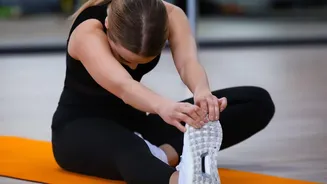
The butterfly stretch is a simple yet effective way to open the inner thighs and hips. Sit on the floor with your back straight. Bring the soles of your feet together and let your knees fall out to the sides. The closer you pull your heels toward your body, the more intense the stretch will be. Hold onto your ankles or feet and gently press your knees down toward the floor using your elbows, or just allow gravity to do the work. Avoid bouncing. Focus on sitting tall and breathing deeply, feeling the release in your groin and hips. Hold for 30 seconds.
5. Glute Bridge
While not a passive stretch, the glute bridge is a crucial exercise for activating and strengthening the glutes—muscles that often become weak from prolonged sitting. Strong glutes help support the pelvis and take pressure off the hip flexors. Lie on your back with your knees bent, feet flat on the floor hip-width apart, and your arms by your sides. Engage your core and glutes to lift your hips off the floor until your body forms a straight line from your shoulders to your knees. Squeeze your buttocks at the top and hold for a few seconds before slowly lowering back down. Aim for 2–3 sets of 10–15 repetitions.