


A Priceless Cosmic Time Capsule
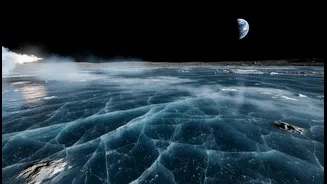
Deep within craters at the lunar poles lie regions that have been dark and frozen for billions of years. These permanently shadowed regions (PSRs) are among the coldest places in our solar system. Because of the Moon's slight axial tilt, the sun never
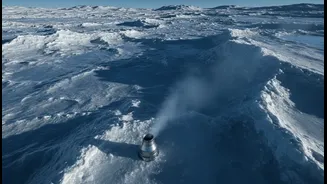
reaches their floors, creating perfect cold traps for ice. This isn't just any ice; scientists believe it contains a priceless, undisturbed record of the early solar system. Trapped within this ancient frost could be water from primordial comets and asteroids, and even prebiotic organic molecules—the chemical building blocks that may have led to life on Earth. Studying this ice in its pristine state offers a rare window into the origins of water in our cosmic neighborhood and potentially life itself. It's a fossil record of our solar system, preserved in deep freeze.
The Threat from Above
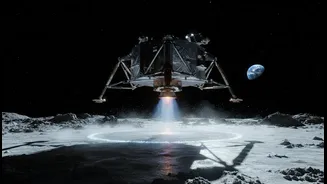
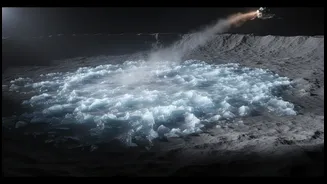
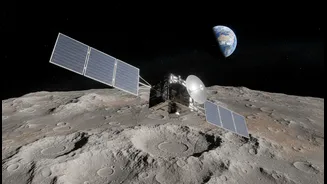
The problem arises the moment a spacecraft begins its descent. To land softly, a lunar lander fires its engines, spewing hot gases and propellant exhaust. On Earth, our thick atmosphere would contain this. But on the airless Moon, these gases expand rapidly, creating a temporary, globe-spanning atmosphere. Recent studies and computer simulations show that exhaust gases, such as water vapor and methane from landers, don't just stay at the landing site. They can spread across the entire lunar surface in a matter of hours or days. The molecules essentially "hop" ballistically across the surface, energized by sunlight and slowed by cold temperatures. This creates a significant risk, as a substantial portion of these exhaust gases will inevitably find their way into the polar cold traps.
Irreversible Scientific Damage
Once these exhaust gases settle in the permanently shadowed craters, they freeze and mix with the ancient ice. This contamination could be irreversible. The introduction of Earth-sourced water vapor, methane, and other organic compounds from rocket fuel can confound scientific measurements. It would become incredibly difficult, if not impossible, for scientists to distinguish between the original, ancient molecules and the new contaminants. Reading the cosmic history book would be like trying to read a page that has had ink spilled all over it. Senior scientists at the European Space Agency have warned that this contamination could hinder, and paradoxically even destroy, the very scientific exploration these missions are meant to enable. We risk erasing the answers before we've even had a chance to ask the questions.
A New Era of Rules and Responsibility
This looming threat is forcing a conversation about the rules of the road for lunar exploration. For decades, "planetary protection" policies have guided missions to prevent the forward contamination of other worlds with Earth-based life. However, the Moon has generally been considered a lower-risk environment, with current NASA requirements mainly focusing on reporting inventories of organic materials. The new generation of larger, more powerful landers, especially those being developed for NASA's Artemis program and by private companies, changes the calculus. These missions are specifically targeting the polar regions for their water resources. This has led scientists and international bodies to call for an updated, more robust approach to lunar planetary protection, balancing the drive for exploration and resource utilization with the need to preserve these unique scientific sites.
The Delicate Balance of Progress
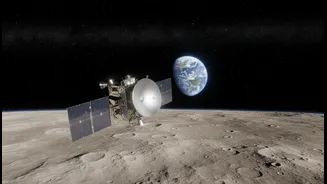
The challenge highlights a fundamental tension in the new era of space commercialization: progress versus preservation. The water ice at the poles is not only a scientific treasure but also a critical resource for future lunar bases, providing drinking water, breathable air, and even rocket propellant. Accessing it is a key goal for making a sustained human presence on the Moon feasible. However, the very act of getting there and setting up operations could spoil the scientific value of these deposits forever. Researchers are now urging that monitoring the spread of exhaust gases become a routine part of all lunar missions. Decisions made in the coming years about landing sites, lander technologies, and international protocols will determine whether we treat the Moon's poles as a priceless archive to be carefully studied or simply a resource to be exploited, potentially at a great scientific cost.