






A Salty Surprise on a Pink Planet
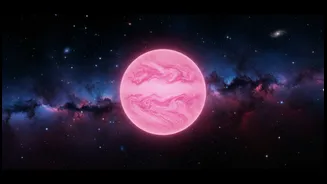
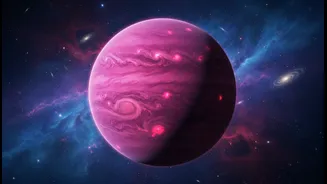
For over a decade, a celestial object known as GJ 504 b has puzzled scientists. Discovered in 2013, its distinct rosy hue earned it the nickname the 'Pink Planet'. It's a massive world, roughly 25 times the mass of Jupiter, and it exists in a strange
middle ground between a giant planet and a brown dwarf, or 'failed star'. What makes it particularly difficult to study is its temperature. At around 550 degrees Fahrenheit, it's scorching by Earth standards but unusually cold for a body of its size, making it too faint for most ground-based telescopes to analyze in detail. This is where the James Webb Space Telescope changed the game. In what took only a couple of hours of observation time, a feat previously impossible, the JWST captured the planet's atmospheric fingerprint. The data revealed water, methane, and carbon dioxide, but the models only made sense when scientists added a surprising ingredient: clouds made of salt.
The Technological Leap of JWST
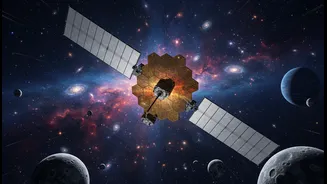
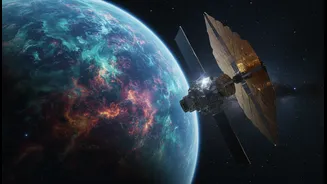
This discovery is not just a scientific curiosity; it's a monumental testament to the technological investment embodied by the James Webb Space Telescope. The business of space exploration is driven by pushing the boundaries of what our instruments can detect. For years, scientists had theorized that salt clouds could exist on worlds with temperatures too hot for ammonia clouds (like Jupiter's) but too cool for silicate clouds (found on much hotter exoplanets). However, there was no direct evidence. The 'Pink Planet' was the perfect candidate, but its faintness was a barrier. JWST's unparalleled sensitivity in the infrared spectrum allowed astronomers to finally capture the faint light from GJ 504 b's atmosphere and find the chemical signatures that salt clouds were blocking. This success validates the telescope's design and justifies the billions invested in its development, opening up a new class of cold, faint objects for study that were previously beyond our reach.
More Than Just a Seasoning
Finding salt clouds is significant because it fills a major gap in our understanding of planetary atmospheres. Clouds play a critical role in a planet's climate and chemistry, and identifying their composition helps create a complete picture of that world. On GJ 504 b, the salt clouds are likely made of compounds like potassium chloride or zinc sulfide, existing as mineral particles suspended high in the atmosphere. By successfully modeling these clouds, astronomers can now better interpret the data from other similar worlds. It's a crucial reminder that our assumptions about planetary atmospheres need to be flexible and that new discoveries often require us to refine our models. This finding also suggests the planet might be unusually rich in heavy elements, which offers clues about whether it formed more like a planet or a small star, a debate that is still ongoing.
The Next Frontier of Discovery
The detection of salt clouds on GJ 504 b is a stepping stone. Scientists believe the techniques used in this study will be vital for analyzing other cold worlds, including those closer to home. For example, Jupiter is known to have clouds of ammonia ice, but current instruments struggle to characterize them in detail. This breakthrough suggests we are getting closer to being able to peer into the atmospheres of gas giants in our own solar system with unprecedented clarity. The discovery also energizes the broader search for worlds beyond our solar system. Each time the JWST is pointed at a new target, from the icy bodies in our own Kuiper Belt to distant exoplanets, it reveals a universe more complex and dynamic than previously imagined. These findings not only generate new scientific questions but also fuel public imagination and drive the case for future investment in space exploration technologies and missions.