
The Sun’s Volatile Temper
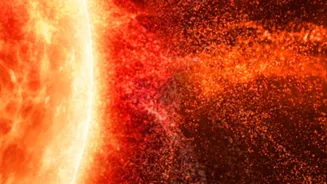
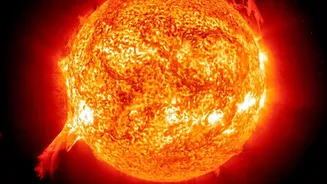
Space weather isn't about clouds or rain; it's the term for the volatile conditions in space driven by our own star. The Sun constantly releases a stream of charged particles known as solar wind. But sometimes, it unleashes much more violent outbursts.
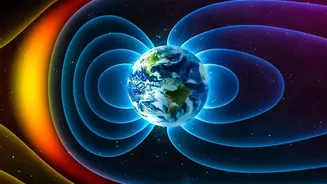
Solar flares are intense bursts of radiation, while Coronal Mass Ejections (CMEs) are colossal eruptions of plasma and magnetic fields hurled into space. When Earth is in the path of these events, they can have significant consequences for our technology-dependent society. While our planet's magnetic field and atmosphere protect us from the worst of it, strong solar storms can overwhelm these natural shields.
A Storm in the Digital Sky
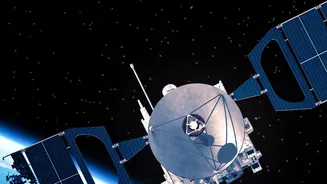
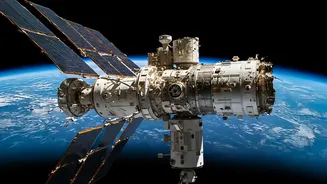
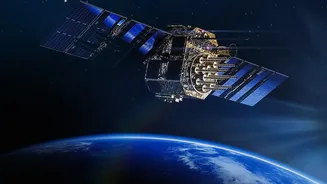
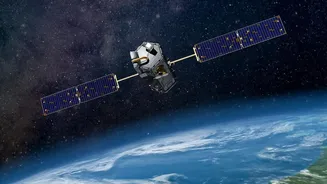
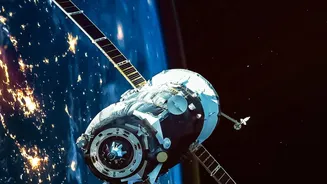
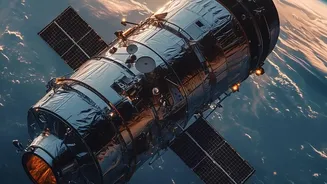
Satellites are uniquely vulnerable because they operate outside Earth's protective atmospheric blanket. A severe solar storm can disrupt them in several ways. Firstly, the storm can heat and expand the upper atmosphere, increasing the drag on satellites in low-Earth orbit. This can cause them to lose altitude and even burn up, as happened to a batch of Starlink satellites in 2022. Secondly, high-energy particles from a solar event can damage or degrade sensitive electronics and solar panels, shortening a satellite's lifespan. Thirdly, the storms interfere with the radio signals that satellites use to communicate with the ground. This can distort GPS signals, leading to navigation errors of several metres, and cause blackouts for high-frequency radio used by aviation and shipping.
The Push for Better Forecasts
Recognizing the growing risk, space agencies and scientists are developing new ways to get ahead of solar storms. Current forecasts often rely on spacecraft like NOAA's recently operational SOLAR-1, positioned at a point about 1.5 million kilometres from Earth. This gives us, at best, a warning of only 15 to 60 minutes for the fastest CMEs. To improve this, new missions are aiming to provide much earlier warnings. The European Space Agency's HENON mission, scheduled for a 2027 launch, will carry an instrument called MAGIC to measure the Sun's magnetic field much farther out. This could extend the warning time for severe storms to several hours, giving operators crucial time to protect satellites and power grids. Other projects, like one led by Aberystwyth University, are using data from special telescopes to create more accurate models of the Sun's magnetic field, which is key to predicting when and where an eruption might occur.
Protecting Our Modern World
The stakes have never been higher. Our global economy is built on a foundation of satellite services. Financial transactions, logistics, precision agriculture, and national security all depend on uninterrupted satellite communication and navigation. The rapid growth of massive satellite constellations in low-Earth orbit, while boosting global internet access, also increases the number of assets at risk. A worst-case solar storm, a once-in-a-century event, could potentially knock out numerous satellites, disrupt power grids by inducing currents in transmission lines, and cause communication outages lasting days or even weeks. This makes the scientific push for better solar weather insights not just an academic exercise, but an essential part of protecting the world's critical infrastructure.