



The Universe’s Official Birth Certificate
The current, widely accepted age of the universe is 13.8 billion years. This number comes from the standard model of cosmology, known as the Lambda-CDM model. It’s the framework that best explains many of the universe’s grandest features, from the faint
afterglow of the Big Bang (the Cosmic Microwave Background) to the large-scale structure of galaxies. This model assumes the universe began with the Big Bang and has been expanding ever since, with its evolution shaped by normal matter, and the more mysterious 'dark matter' and 'dark energy'. Scientists calculate the age by measuring the current expansion rate and running the clock backwards to the beginning.
A Radical New Timeline
A new proposal from University of Ottawa adjunct professor Rajendra Gupta challenges this picture entirely. His model, known as CCC+TL, estimates the universe is actually 26.7 billion years old. This isn't just a small adjustment; it doubles the cosmic timeline. The theory does this by blending two different and controversial ideas. The first is that the 'fundamental constants' of physics, which govern forces like gravity and electromagnetism, might change over time. The second is a revival of an old idea called 'tired light'.
What is 'Tired Light'?
The 'tired light' theory was first proposed in 1929 by astronomer Fritz Zwicky. In our expanding universe, light from distant galaxies appears 'redshifted'—its wavelength is stretched out as the galaxy moves away from us. The farther the galaxy, the greater the redshift, which is how we estimate distance. Zwicky suggested an alternative: what if the universe wasn't expanding, and light simply lost energy—or got 'tired'—on its long journey across the cosmos? This idea was largely dismissed because the standard model of expansion explained observations much better. Gupta's new model merges a modified tired light concept with the expanding universe, suggesting the redshift we see is a hybrid of both effects.
Solving the 'Impossible Galaxy' Problem
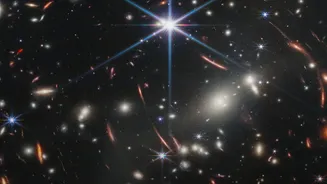
So, why propose such a drastic change? One major motivation is the 'impossible early galaxy problem'. Recent observations from the James Webb Space Telescope (JWST) have revealed galaxies from the early universe that are surprisingly massive and mature. Under the standard 13.8-billion-year model, these galaxies would have formed just a few hundred million years after the Big Bang, which doesn't seem like enough time to grow so large and complex. An older universe provides a simple solution: these galaxies weren't impossibly quick to form; they just had billions of extra years to develop. Gupta’s model also claims to explain the rotation of galaxies without needing to invoke undetected dark matter.
Skepticism and The Path Forward
While fascinating, the 26.7-billion-year-old universe is far from a proven fact. It remains an idea on the fringes of mainstream cosmology. The Lambda-CDM model, for all its quirks like dark matter and dark energy, successfully explains a vast range of observational data, a high bar for any new theory to meet. Critics of tired light theories point out that they have historically failed key tests, like explaining the sharpness of distant galaxy images and the precise temperature of the cosmic microwave background. Proponents of the new CCC+TL model say their framework can account for these observations and warrants further investigation. The scientific community will now put this new idea through rigorous testing to see if it holds up to scrutiny.