



A Day Longer Than a Year
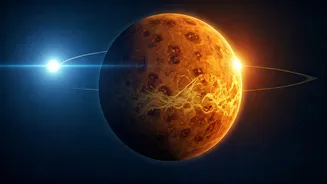
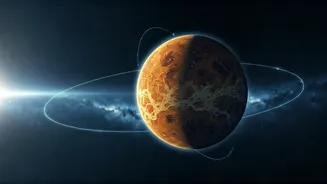
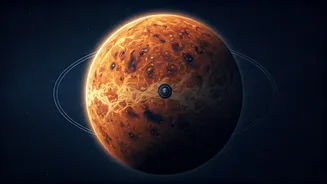
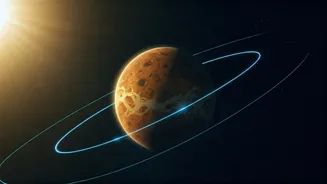
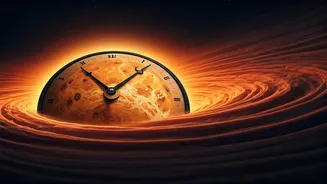
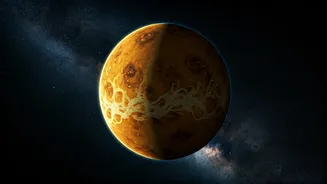
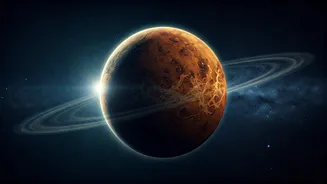
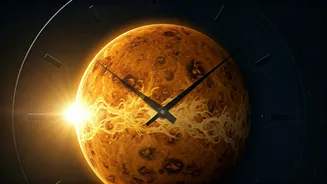
Let’s get the mind-bending numbers out of the way first. Venus takes about 225 Earth days to complete one orbit around the Sun. That’s its year. However, it rotates on its axis incredibly slowly, taking 243 Earth days to complete just one turn. This means
a single sidereal day on Venus (one full rotation) is longer than a Venusian year. If you could stand on its surface, you’d have to wait 117 Earth days between sunrises because of the combination of its slow spin and its orbit. While you aged a year on Venus, you wouldn't have even experienced two full day-night cycles. This makes Venus a true outlier in our solar system, where most planets have days that are a tiny fraction of their years.
Spinning the Wrong Way
As if its lethargic spin wasn’t strange enough, Venus also rotates backwards. Every planet in our solar system orbits the Sun in the same direction, and almost all of them spin on their axis in that same direction (counter-clockwise if viewed from above the Sun's north pole). But Venus is a rebel. It spins clockwise, a phenomenon known as retrograde rotation. This means if you were on Venus, the Sun would rise in the west and set in the east. Only Uranus, which is tilted so far over it’s essentially rolling on its side, has a similarly strange rotation. This backward spin is a major hint that something dramatic happened in Venus’s deep past.
Why the Cosmic Slowdown?
Scientists don't have one definitive answer, but there are two leading theories for Venus’s peculiar rotation. The first involves colossal impacts. Early in the solar system’s history, the protoplanetary disk was a chaotic shooting gallery. One theory suggests that Venus was struck by one or more massive planet-sized objects. Such a collision could have been powerful enough to not just halt its original, faster rotation but actually reverse it, leaving it with the slow, backward spin we see today. The second, more recent theory, points to Venus's own atmosphere. Its atmosphere is incredibly thick and heavy—90 times denser than Earth's. This dense, flowing ocean of air creates immense friction with the surface, acting like a powerful brake. Over billions of years, this atmospheric 'tidal lock' could have slowed the planet's rotation to its current crawl. It’s possible that both factors—an ancient impact and atmospheric drag—worked together to create the oddball planet we see today.
Life in the Slow Lane
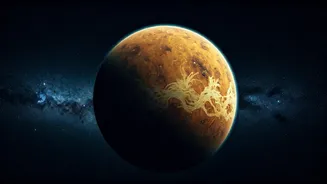
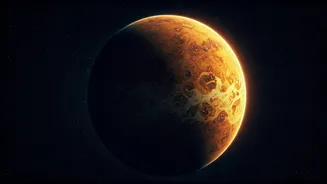
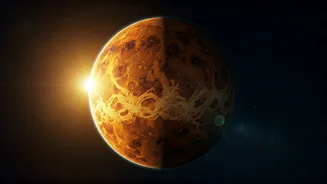
This leisurely rotation has profound consequences for the planet's environment. On Earth, our relatively quick 24-hour spin helps distribute the Sun's heat, creating the moderate day-night temperature cycles that life depends on. On Venus, one side of the planet faces the sun for months at a time, baking under relentless solar radiation, while the other side is plunged into a long, dark night. This doesn't create a frozen side, however, because the thick atmosphere is incredibly effective at trapping and circulating heat. This has contributed to a runaway greenhouse effect, making Venus the hottest planet in the solar system. Its surface temperature is a blistering 465°C, hot enough to melt lead, and the atmospheric pressure is equivalent to being 900 metres underwater on Earth.
Unmasking Earth's Twin
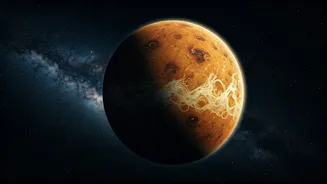
For centuries, Venus was shrouded in mystery, hidden beneath a permanent blanket of thick, sulfuric acid clouds. Early astronomers had no idea what its surface looked like or how fast it was spinning. It was only in the 1960s, with the advent of powerful radar telescopes on Earth, that scientists were able to bounce signals off the surface and measure its rotation for the first time. The results were shocking. Later, missions like NASA's Magellan orbiter used radar to map over 98% of the planet's surface, confirming the slow, retrograde rotation and revealing a world of volcanoes and deformed crust, shaped by forces we are still struggling to understand.