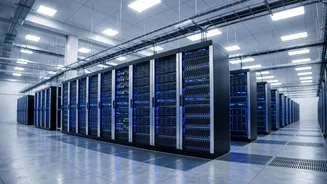








India's digital backbone is set for a monumental upgrade. A recent Crisil report forecasts a fivefold explosion in data centre capacity by 2030, an expansion powered by over Rs 3 lakh crore in investments. But what do these numbers mean?
Decoding the Fivefold Surge
Imagine the engine
rooms of the internet—massive, secure buildings filled with computer servers that store, process, and deliver everything from your emails to streaming video. These are data centres. According to Crisil, India's capacity to power these digital factories is set to leap from around 1.5 GW today to a colossal 7.5 GW by March 2030. This isn't just a gradual increase; it's an investment supercycle. The projected Rs 3 lakh crore investment over the next few years signifies a fundamental belief in India's digital future. This growth is largely pre-validated, with nearly half of the upcoming capacity already leased out on long-term contracts of 15-20 years, primarily to 'hyperscalers'—the global tech giants that power cloud computing. This reduces financial risk and signals strong, sustained demand.
The Engines of Explosive Growth
Three powerful forces are converging to fuel this unprecedented demand. First is the data deluge from enterprise digitalisation, rising data consumption, and the nationwide 5G rollout, which connects more devices and generates more information than ever before. Second is the revolutionary impact of Generative AI (GenAI). Training and running AI models requires immense computational power, making data centres the essential infrastructure for the AI boom. Third, India's cost advantage makes it a globally competitive destination. Development costs for data centres in India are roughly 20% lower than in other Asia-Pacific markets, and rental rates can be 30-35% cheaper, thanks to more affordable land, construction, and power.
The Power and Sustainability Challenge
This massive expansion comes with significant challenges, chief among them being power. Data centres are incredibly power-hungry. Crisil notes that the upcoming capacity will be heavily concentrated in hubs like Mumbai, Hyderabad, and Visakhapatnam. In these cities, data centres could eventually consume a staggering 60% to 80% of their current peak power demand. This puts immense pressure on local electricity grids and makes timely upgrades to power infrastructure a critical factor for success. Furthermore, there is a growing environmental concern regarding the enormous water and energy consumption of these facilities. To counter this, and to meet the sustainability goals of their global clients, developers are increasingly focused on building large campuses that can be powered by renewable energy, a key factor in maintaining India's competitive edge.
More Than Just Digital Real Estate
The impact of this buildout extends far beyond the tech sector. It represents the physical foundation of India's ambition to become a 20% digital economy by 2030. This growth creates a virtuous cycle, attracting foreign investment and enabling other industries—from finance to entertainment and manufacturing—to innovate and scale their digital operations. The dependency on hyperscalers, who are expected to lease up to 80% of the capacity by 2030, presents a concentration risk but also anchors the ecosystem with stable, creditworthy tenants. For the broader economy, this boom means a significant opportunity for banks and insurers, with potential lending for physical infrastructure estimated to be between ₹1.2 trillion and ₹3.5 trillion. Ultimately, building this critical infrastructure is about securing India's data sovereignty and equipping the nation for the next wave of technological transformation.