






The Evidence: A Prebiotic Chemical Laboratory
The scientific motivation for visiting Titan is built on decades of tantalizing data. When the European Space Agency's Huygens probe descended through Titan’s atmosphere in 2005, it revealed a world that is eerily Earth-like yet fundamentally alien. The surface
has terrain shaped by flowing liquids, but the rivers and lakes are filled with liquid methane and ethane, not water. The bedrock is made of water ice, as hard as rock at the frigid surface temperature of around minus 179 degrees Celsius. More importantly, Titan’s dense, nitrogen-rich atmosphere is a factory for complex organic molecules. Sunlight and radiation from Saturn’s magnetosphere break down methane and nitrogen, which then recombine into a rich variety of carbon-based compounds that rain down onto the surface. Scientists believe this environment mirrors the conditions of early Earth, before life began. It is a natural laboratory for studying prebiotic chemistry—the steps that might lead from simple organic molecules to the building blocks of life. Evidence suggests that in places where impacts or cryovolcanism might have melted the ice, these organics could have mixed with liquid water, creating a temporary soup where molecules like amino acids could form.
The Opportunity: A Flying, Nuclear-Powered Scientist
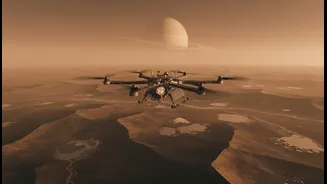
Dragonfly is not a rover, limited to a single landing site. It's an octocopter—a drone with eight rotors—designed to fly across Titan’s surface. This is possible because Titan has a unique combination of low gravity and a dense atmosphere (four times denser than Earth's), making flight much easier than on Mars. Over its planned three-year science mission, Dragonfly will perform a series of 'hops', flying to dozens of locations several kilometers apart. This mobility is the mission's greatest strength, allowing it to sample diverse geological environments, from organic-rich sand dunes to the floor of an impact crater, Selk crater, where liquid water may have once persisted. The rotorcraft carries a sophisticated suite of instruments. A mass spectrometer will analyze the chemical makeup of the surface to search for complex organic molecules and potential biosignatures. A drill will acquire samples from beneath the surface, and a geophysics and meteorology package will study the atmosphere and subsurface. The goal isn't necessarily to find existing life, but to understand how far prebiotic chemistry has progressed in this alien environment.
The Limits: Extreme Engineering and Budgetary Hurdles
The ambition of Dragonfly is matched only by its challenges. Operating a robotic flyer on a world over a billion kilometers away is an immense technological feat. The two-hour descent through Titan's thick atmosphere will be a prolonged period of high risk. Once on the surface, the craft must survive extreme cold while also managing the heat from its nuclear power source, a Multi-Mission Radioisotope Thermoelectric Generator (MMRTG). Ironically, engineers found the craft could risk overheating on a calm day just as it could freeze in a breeze. Every flight will be autonomous; with a round-trip communication delay of nearly three hours, there is no real-time piloting from Earth. The machine must navigate itself, choose landing spots, and handle unexpected conditions on its own. The mission has also faced significant terrestrial challenges. The launch date has been pushed back to July 2028, with arrival at Titan now expected in 2034. The mission's lifecycle cost has ballooned to $3.35 billion, a significant increase from initial projections that has strained NASA's planetary science budget and delayed other projects. These hurdles underscore the immense complexity and cost of pushing the boundaries of solar system exploration.