
What Exactly Is a Solar Storm?
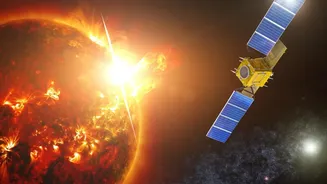
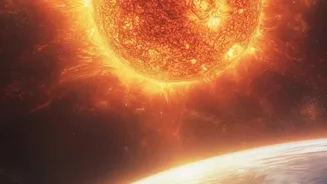
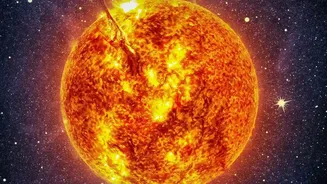
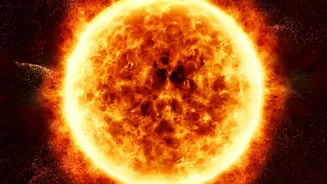
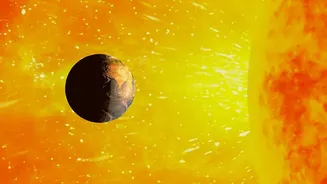
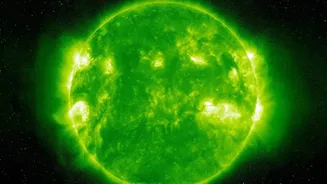
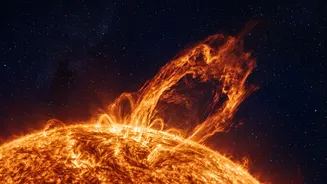
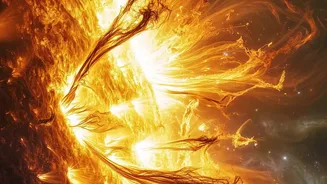
A solar storm is a disturbance on the sun, a powerful blast of energy and matter. Think of it as weather in space. These events are driven by the sun's tangled magnetic fields. When these fields twist and snap like a rubber band, they can release enormous
amounts of energy in two main forms: solar flares and coronal mass ejections (CMEs). A solar flare is an intense burst of radiation, a giant flash of light that can disrupt radio communications on Earth almost instantly. A CME is even more significant; it's a massive cloud of magnetised plasma and solar particles that gets hurled into space at millions of miles per hour. While not all storms are directed at Earth, the ones that are can cause significant disturbances.
The Journey From Sun to Earth
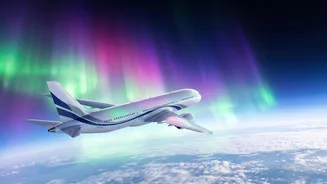
When a CME is aimed at our planet, its cloud of charged particles travels across the 150 million kilometres to Earth, a journey that can take anywhere from less than a day to several days. Earth has a natural defense: its magnetic field, or magnetosphere, which shields us from most solar radiation. However, a powerful CME can slam into this shield and interact with it, triggering what's known as a geomagnetic storm. This interaction transfers huge amounts of energy into our atmosphere, leading to beautiful phenomena like the aurora (northern and southern lights), but also creating dangerous effects on the ground.
Our Vulnerable Power Grids
One of the most significant threats from a geomagnetic storm is to our electrical power grids. The storm's fluctuating magnetic fields can create powerful, uncontrolled electrical currents in long conductors on the ground, like power lines and pipelines. These geomagnetically induced currents can flow into electrical transformers, causing them to overheat and fail. The most famous modern example occurred in March 1989, when a solar storm collapsed the entire Hydro-Québec power grid in Canada in just 90 seconds, leaving six million people without electricity for up to twelve hours in freezing temperatures.
Disrupting Communications and GPS
Space weather also wreaks havoc on the systems we rely on for navigation and communication. The energy from solar storms can heat and distort the ionosphere, a layer of Earth's atmosphere that radio signals bounce off of. This disruption can degrade or block high-frequency radio communications used by airlines and emergency services. It also affects Global Positioning System (GPS) signals, which must pass through the ionosphere to reach receivers on the ground. A storm can delay these signals, reducing GPS accuracy from a few metres to complete signal loss, impacting everything from aviation and shipping to precision agriculture.
The Ultimate Test: The Carrington Event
To understand the worst-case scenario, we look to the past. In 1859, the most intense geomagnetic storm in recorded history, known as the Carrington Event, struck Earth. Observed by British astronomer Richard Carrington, the associated solar flare was so bright it was visible to the naked eye. The resulting storm was powerful enough to set telegraph systems on fire and deliver electric shocks to their operators. Auroras were seen as far south as the tropics. If a storm of that magnitude occurred today, it could cause widespread, long-lasting blackouts and damage satellites, with recovery taking months or even years.
Are We Prepared for the Next Big One?
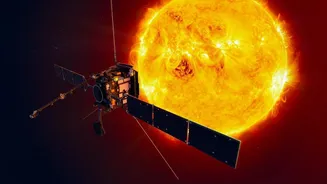
Scientists are constantly monitoring the sun for signs of trouble. Agencies like NOAA's Space Weather Prediction Center provide forecasts and warnings, allowing power grid operators and satellite companies to take protective measures. We are currently in an active phase of the sun's 11-year cycle, known as Solar Cycle 25, which is proving more active than initially predicted and is expected to continue its peak activity through 2026. This heightened activity makes understanding and preparing for space weather more important than ever. While we are more technologically vulnerable than in 1859, our ability to forecast these events gives us a critical advantage.