




The Constant Battle Against Drag
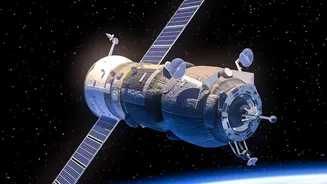
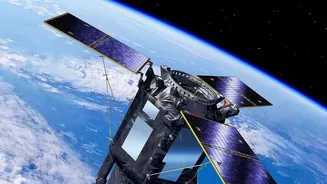
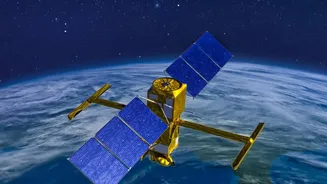
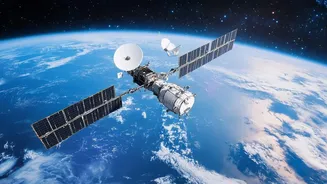
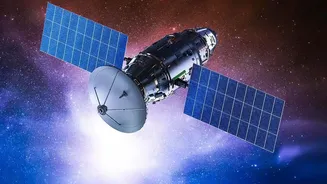
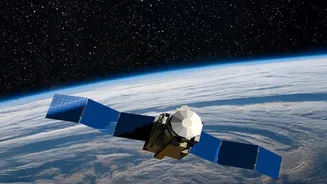
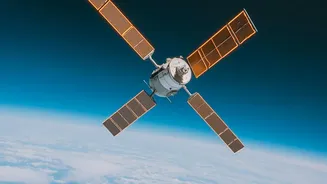
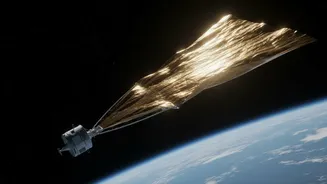
For satellites in Very Low Earth Orbit (VLEO), typically below 450 kilometres, the mission is a constant struggle against gravity and atmospheric drag. While the air is incredibly thin, it's not a perfect vacuum. Sparse molecules of oxygen and nitrogen
constantly bombard the spacecraft, slowing it down and causing its orbit to decay. Without a propulsion system to provide regular boosts, these satellites would fall back to Earth within months or even days. Conventionally, this means carrying a finite supply of propellant, like xenon gas, for ion thrusters. When the fuel runs out, the mission is over. This fundamental limitation has historically restricted the duration and scope of low-orbiting missions.
Turning a Problem into a Propellant
Atmosphere-Breathing Electric Propulsion (ABEP) flips this problem on its head. Instead of treating atmospheric drag as a pure nuisance, this technology harnesses the very particles that cause drag and uses them as an inexhaustible source of fuel. The concept is elegantly simple: if you can collect the residual air molecules, you can use them as propellant for an electric thruster. This would eliminate the need for bulky onboard fuel tanks, potentially allowing a satellite to operate as long as its solar panels and electronics function. This could usher in a new era of long-duration, sustainable missions for everything from high-resolution Earth observation to low-latency communications.
The Intake: Scooping Molecules at 28,000 KPH
The first critical component of an ABEP system is the intake. This isn't a jet engine scoop as we know it, but a specially designed collector that funnels in sparse atmospheric particles as the satellite hurtles along at orbital speeds of nearly 8 kilometres per second. The intake must be incredibly efficient at collecting these particles and compressing them enough to be fed into the thruster. There are no complex moving parts like valves; the entire process works passively, relying on the spacecraft's high velocity to ram the molecules into the collection system. European Space Agency (ESA) backed projects have developed and tested prototypes that successfully demonstrate this collection process in simulated VLEO environments.
From Air to Thrust: The Electric Engine
Once collected, the atmospheric gases—mostly nitrogen and oxygen—are channelled into an electric thruster. Powered by the satellite's solar arrays, the thruster uses electrical energy to ionize the gas, stripping electrons from the atoms to create a plasma. This charged plasma is then accelerated by electromagnetic fields and expelled at extremely high velocity, generating a gentle but continuous thrust. This thrust is precisely what's needed to counteract the constant force of atmospheric drag, allowing the satellite to maintain its altitude indefinitely. In 2018, an ESA-led team successfully conducted the world's first test firing of a complete air-breathing thruster system, proving the concept was no longer just a theory.
A Future of Limitless Orbits
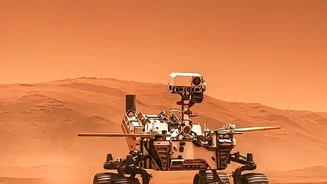
The implications of this technology are vast. Satellites could operate for much longer in VLEO, providing higher-resolution imagery and faster communication than their higher-orbiting counterparts. It also promotes a more sustainable use of space; when an ABEP-equipped satellite's mission ends, it can simply be powered down, and the natural atmospheric drag will cause it to deorbit and burn up, leaving no space debris behind. Research groups and space agencies, including ESA and commercial companies, are actively developing the technology, with recent advancements in 2026 focusing on making the systems smaller and more efficient for satellite constellations. The technology could even be adapted for other worlds, using the thin carbon dioxide atmosphere of Mars to power future exploratory missions.