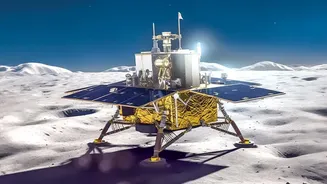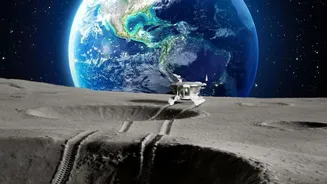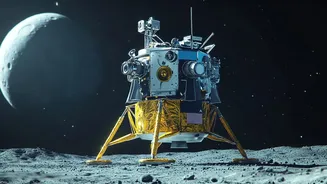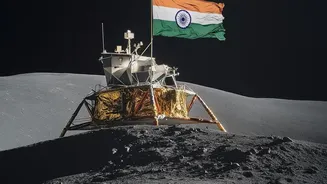





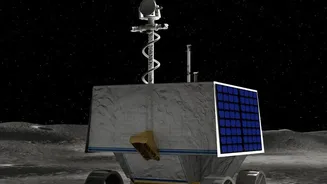
After the historic success of Chandrayaan-3, the Indian Space Research Organisation (ISRO) is setting its sights on an even more ambitious goal: bringing a piece of the Moon back to Earth. Enter Chandrayaan-4, a mission of immense complexity and national
importance.
India's Next Giant Leap
Chandrayaan-4 represents a monumental step forward from its predecessors. While Chandrayaan-1 discovered water molecules and Chandrayaan-3 successfully soft-landed near the lunar south pole, this next phase is designed to perform a round trip. The mission's primary objective is to land on the Moon, collect samples of lunar regolith (soil) and potential water ice, and return them safely to Earth for study. If successful, India will join an elite club of nations—the United States, Russia, and China—that have accomplished this challenging feat. The mission is part of India's broader Space Vision 2047, which includes establishing a space station by 2035 and landing an Indian astronaut on the Moon by 2040.
A Mission of Unprecedented Complexity
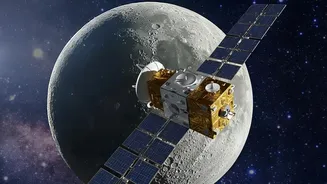
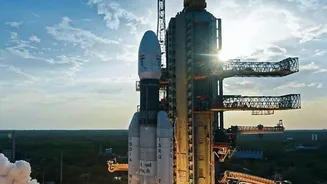
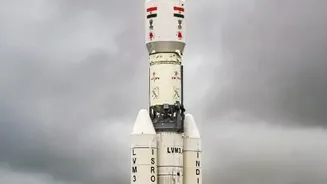
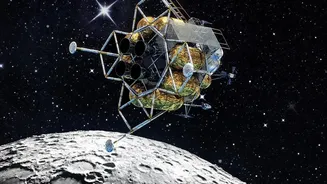
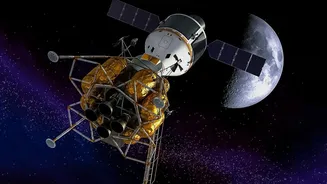
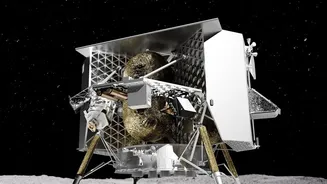
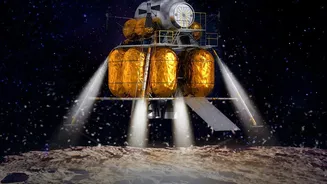
Calling Chandrayaan-4 complex is an understatement. The mission architecture is a sophisticated dance of advanced engineering involving five separate modules: a Propulsion Module, Descender Module, Ascender Module, Transfer Module, and a Re-entry Module. Due to the sheer weight, the components are planned to be launched on two separate heavy-lift LVM3 rockets. Once in orbit, these modules will perform a series of autonomous rendezvous and docking manoeuvres—a critical capability ISRO has been actively testing. After assembling into an integrated spacecraft, it will journey to the Moon, where the lander will touch down in the scientifically valuable south polar region.
The Delicate Task of Retrieval
Once on the lunar surface, the mission's robotic arm will get to work, collecting up to two kilograms of soil and drilled samples. These precious materials will be sealed in a container to protect them from contamination. The next critical step involves the Ascender module launching itself off the Moon's surface—a first for India—to rendezvous and dock with the orbiting Transfer Module. The sample container will be transferred for the long journey home. This entire sequence, from automated collection to launching from another celestial body, requires a level of precision and robotics far beyond any previous ISRO mission.
Why Bring Back Moon Rocks and Ice?
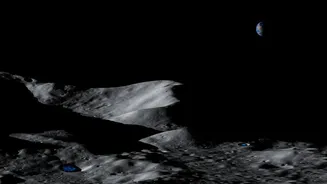
While rovers can perform on-site analysis, studying samples in labs on Earth offers unparalleled scientific insight. The targeted landing site near the south pole is believed to hold water ice in its permanently shadowed regions. This ice is a resource of immense interest, not just for understanding the Moon's history but also for its potential to produce breathable air, drinkable water, and rocket fuel for future crewed missions. The returned soil will be analyzed using advanced equipment too large and delicate to send to space, helping scientists unlock secrets about the formation of the Moon, Earth, and our solar system. Having physical samples also gives India a literal seat at the table for international collaboration and sample exchanges.
Paving the Way for a Lunar Future
The technologies being developed for Chandrayaan-4 are foundational for India's long-term space ambitions. Mastering orbital docking, lunar ascent, and high-speed Earth re-entry are not just for this mission; they are essential building blocks for sending humans to the Moon and bringing them back safely. The Union Cabinet approved the mission with a significant budget, signalling its national priority. While initial timelines pointed to 2027, the immense technical challenges of a first-of-its-kind mission suggest a launch closer to 2028 is more likely. Chandrayaan-4 is more than a scientific quest; it is a demonstration of India's maturing spacefaring capabilities and its readiness to take on the next generation of cosmic challenges.