




Understanding the Gaganyaan Mission
The Gaganyaan programme is India's historic endeavor to demonstrate human spaceflight capability by launching a crew of three astronauts into a 400 km low Earth orbit for a three-day mission. Upon successful completion, the astronauts will be brought
back safely, splashing down in Indian waters. This ambitious project will make India the fourth country in the world, after the United States, Russia, and China, to independently send humans to space. Before any astronaut boards the spacecraft, ISRO is committed to a series of rigorous uncrewed test flights to validate every system, ensuring the highest standards of safety and reliability.
The Life-Saving Role of Safety Modules
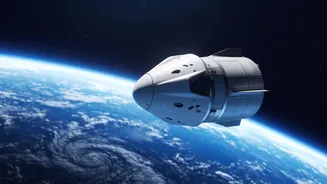
In human spaceflight, nothing is more important than crew safety. The 'safety modules' are a suite of technologies designed to protect the astronauts during the most critical phases of the mission, particularly launch. The centerpiece of this is the Crew Escape System (CES). Think of it as a highly advanced ejection seat for the entire astronaut capsule. It's a tower-like structure fixed atop the crew module, packed with powerful, quick-acting solid fuel motors. In the event of a catastrophic failure on the launchpad or during ascent, the CES is engineered to ignite in milliseconds, pulling the crew module and its occupants away from the malfunctioning rocket to a safe distance.
Anatomy of an Abort Test
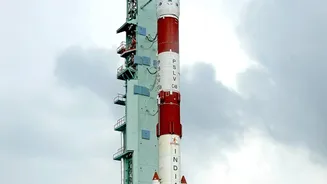
To ensure the Crew Escape System works flawlessly when needed, ISRO conducts what are known as abort tests. These tests simulate emergency scenarios. For instance, the Test Vehicle Abort Mission-1 (TV-D1), which was successfully conducted in October 2023, demonstrated an in-flight abort. A specially designed test rocket launched the unpressurised crew module to a specific altitude, at which point a simulated failure was triggered. The escape motors fired, separating the crew module from the rocket. The module then descended under parachutes for a safe splashdown in the Bay of Bengal, where it was recovered by the Indian Navy. These tests provide invaluable data on the performance of the escape motors, parachute deployment, and structural integrity of the module.
Beyond the Escape System
While the Crew Escape System is vital for launch emergencies, astronaut safety is a multi-layered concern. ISRO has also been qualifying other critical systems. This includes the Crew Module Up-righting System (CMUS), a flotation device that ensures the capsule remains upright after splashing down in the sea, which is essential for recovery operations. Another key component is the system that manages the umbilical connections between the crew and service modules, ensuring a clean separation before re-entry. The human-rated LVM3 rocket itself has been redesigned with redundant systems to be more reliable than a standard satellite launcher. Each of these thousands of tests is a deliberate step toward building a robust, reliable, and safe transportation system to space.
The Road to India's First Crewed Flight
These safety tests are crucial milestones on the path to the main event. According to recent updates, the first uncrewed orbital flight of the Gaganyaan mission, G1, is targeted for the last quarter of 2026. This mission will carry the humanoid robot Vyommitra to test the life-support systems. Following a series of uncrewed flights to prove the systems' reliability, India's first crewed mission is now targeted for 2027. As noted by Group Captain Angad Pratap, one of the astronaut-designates, patience and meticulous preparation are key, as delays are a natural part of developing such a complex, prototype program from the ground up.