



A New Look at a Familiar Galaxy
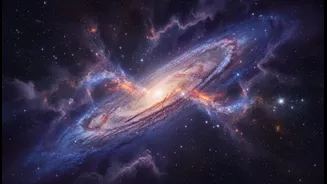
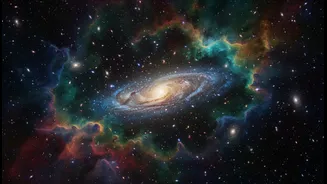
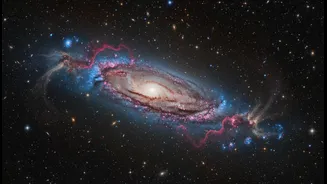
To celebrate the fourth anniversary of the James Webb Space Telescope's (JWST) science operations, the agencies released a spectacular new view of Centaurus A. Located about 11 million light-years away, this makes it one of the nearest large and active
galaxies to our own Milky Way. Centaurus A has long been a subject of fascination and debate among astronomers. It’s often described as a “peculiar” galaxy because of its unusual shape, which is the result of a violent cosmic collision between two separate galaxies that happened around two billion years ago. This merger left it with an abundance of gas and dust, providing the raw materials for intense bursts of star formation. Its proximity and activity make it a perfect natural laboratory for studying how galaxies evolve, especially after such dramatic events.
Peering Through the Cosmic Dust
What makes this new image so revolutionary is Webb's powerful infrared vision. Where telescopes like Hubble saw thick, obscuring lanes of dust, Webb cuts right through them. The result is a transformation; what once looked like a hazy glow is now resolved into a stunning, densely packed tapestry of millions of individual stars. This isn't just a prettier picture; it's a treasure trove of data. Scientists are calling it a case of “galactic archaeology.” By being able to distinguish between different generations of stars, astronomers can reconstruct a timeline of the galaxy's evolution. They can now study which stars formed before the collision, which were born during the cataclysmic merger, and which have formed in the aftermath from the stirred-up gas.
Unraveling a Galaxy’s Secrets
The incredible detail reveals features never seen before. Webb's Mid-Infrared Instrument (MIRI) highlights the galaxy’s rich dust structures, which glow in intricate and sometimes perplexing shapes. Astronomers are intrigued by a strange, parallelogram-like band of dust across the galaxy's centre and a mysterious 'S' shaped feature that invites new questions about its origin. At the heart of Centaurus A lies a supermassive black hole actively feeding on surrounding material. This process launches powerful jets of energy that shape the entire galaxy. By analyzing the light with spectroscopy, Webb can even measure how gas moves within the galaxy, revealing outflows driven by the black hole’s activity. These observations offer new clues about the complex relationship between black holes and star formation.
A Universe of Discovery
While Centaurus A is the anniversary headliner, it's just one piece of the cosmic puzzle being assembled. The synergy between NASA and ESA continues to yield amazing results across different missions. For instance, ESA’s Euclid telescope, with NASA contributions, recently discovered some of the most ancient quasars ever seen, with two dating back to when the universe was just 670 million years old. A quasar is the brilliant core of a galaxy where a supermassive black hole is consuming enormous amounts of matter, releasing more light than all the stars in the galaxy combined. Finding these so early in cosmic history helps scientists understand how the very first galaxies and black holes formed and grew so quickly. Each mission provides a unique window, and together they create a more complete picture of our universe's history and structure.