





The Race Against Resistance
Antimicrobial resistance (AMR) is one of the biggest threats to global health. Common infections are becoming harder to treat as bacteria evolve to withstand our existing antibiotics. By 2050, it's estimated that millions could die each year due to drug-resistant
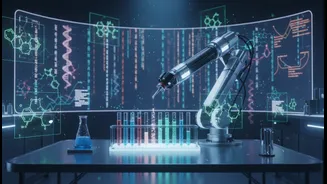
infections. The pipeline for new antibiotics has run dry because traditional discovery methods are slow, expensive, and have a high failure rate. This is where the hype around AI begins. In theory, AI can slash the time it takes to find potential new drugs by sifting through millions of chemical compounds in days, a task that would take humans a lifetime. It's a powerful new tool in a race we can't afford to lose.
How AI Hunts for New Drugs
Think of AI as a hyper-intelligent search engine for medicine. Researchers train deep learning models on vast databases of molecules with known antibacterial properties. The AI learns to recognize the specific structural features that make a compound effective against certain bacteria. Once trained, the model can be unleashed on libraries of millions of other compounds it has never seen before, predicting which ones are most likely to work. For example, in the discovery of a compound named Abaucin, an AI model analyzed over 6,000 compounds in about an hour and a half to find candidates effective against the superbug Acinetobacter baumannii. This radically accelerates the very first step: identifying a promising lead.
The Reality Check: From Screen to Lab
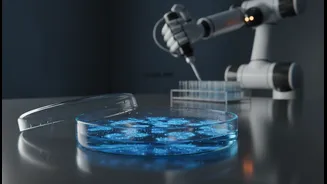
This is the crucial caveat from the headline. An AI's prediction, no matter how promising, is still just a prediction. It's a digital hypothesis. The journey from computer screen to actual medicine involves painstaking real-world science. After the AI flags potential candidates, scientists must first synthesize these molecules in a laboratory. Then, they begin the rigorous process of experimental testing. In the case of Abaucin, the AI produced hundreds of possibilities, which were narrowed to 240 for lab testing. This experimental process revealed only nine active antibiotics, with Abaucin being the most potent. Many AI-generated candidates fail at this early stage, proving ineffective or too difficult to produce. AI gets you to the starting line faster, but it doesn't run the race for you.
The Human Gauntlet: Clinical Trials
Even if a compound proves effective in a petri dish and in animal models, like Abaucin did in mice, it faces the longest and most difficult part of its journey: human clinical trials. This multi-stage process is designed to answer two critical questions: Is the drug safe for humans, and does it actually work in humans? This phase takes years, costs hundreds of millions, if not billions, of dollars, and has an incredibly high failure rate. Only about 10% of drugs that enter clinical trials ever make it to market. AI has not yet demonstrated an ability to significantly improve these late-stage success rates. So far, no fully AI-discovered drug has completed this gauntlet and received market approval, though some are now entering pivotal late-stage trials.
A Powerful Tool, Not a Magic Wand
It's a mistake to think of AI as a replacement for human scientists or the scientific method. It is a cognitive tool that massively enhances one part of the process. AI can identify novel drug candidates, predict their properties, and even help optimize clinical trial design, but it cannot bypass the fundamental need for experimental validation and strict regulatory approval. The true value of AI in drug discovery is making the initial search faster, smarter, and less prone to failure, allowing researchers to place their bets on more promising early-stage candidates. But the path from an algorithm's output to a pill in a bottle remains one of biology's most challenging.