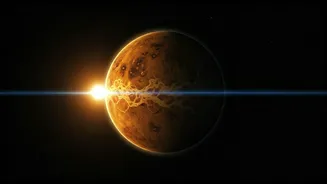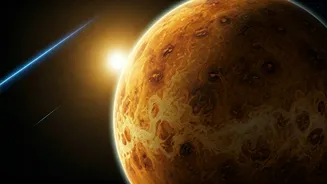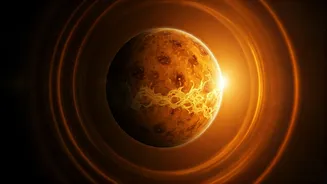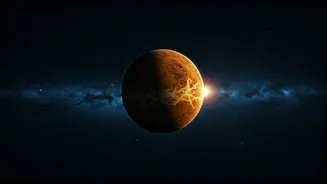




A Year Shorter Than a Day?
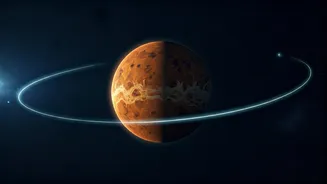
It sounds like a riddle, but it's a simple, albeit strange, matter of celestial timing. On Earth, we experience 365 days in a single year. On Venus, the numbers are completely scrambled. A Venusian year—the time it takes for the planet to complete one
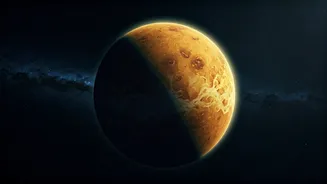
full orbit around the Sun—is about 225 Earth days. However, a single Venusian day—the time it takes for the planet to rotate once on its axis—is approximately 243 Earth days. So yes, you would celebrate your new year's day on Venus before a single day-night cycle has even finished. You could be born, live through a full orbital 'year', and still be in the middle of your first day.
The Two Clocks of a Planet
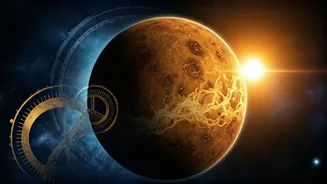
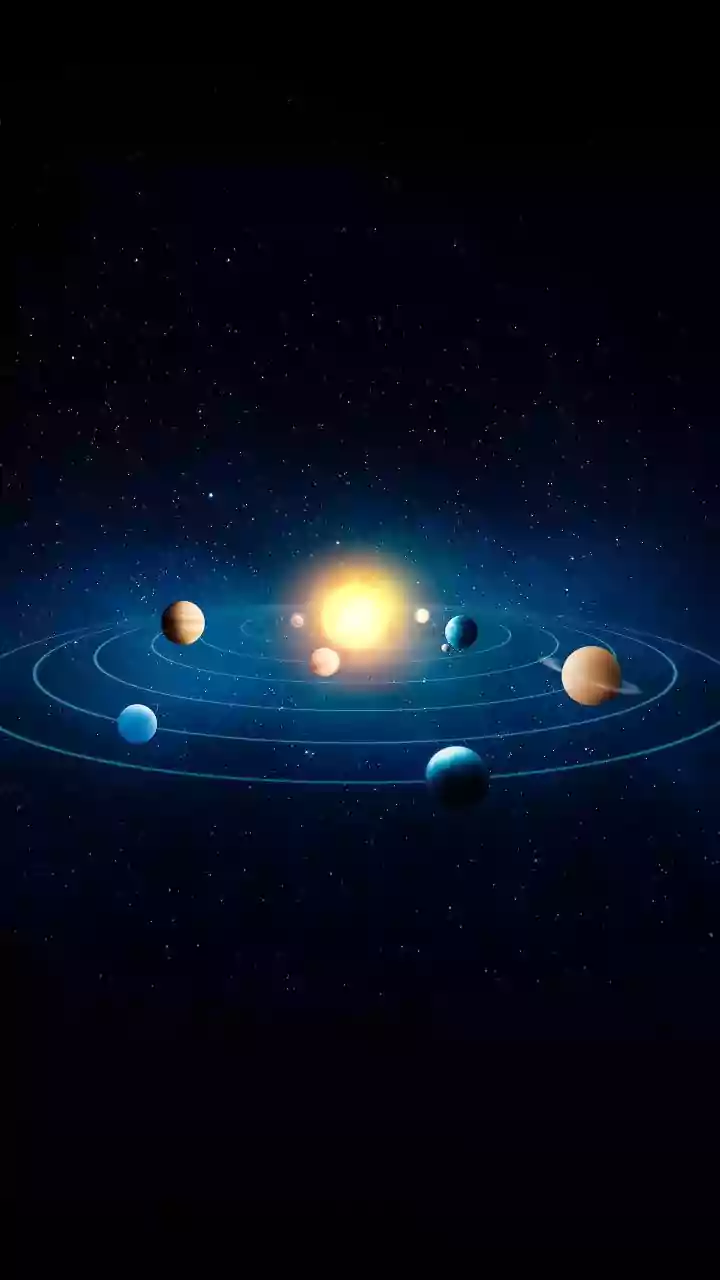
To understand this cosmic paradox, we need to separate two different concepts: orbit and rotation. Think of a planet as a spinning top moving around a central lamp. The 'year' is the time it takes for the top to make a full circle around the lamp. The 'day' is the time it takes for the top to complete one spin on its own axis. For Earth and most other planets in our solar system, the spin is incredibly fast compared to the journey around the Sun. Earth spins on its axis once every 24 hours, while its journey around the Sun takes a leisurely 365.25 days. Venus breaks this pattern. Its journey around the Sun is relatively quick, but its personal spin is the slowest of any planet in our solar system. It crawls on its axis, taking longer to complete one turn than it does to complete its entire solar orbit.
Venus's Slow, Backward Spin
The weirdness doesn't stop there. Not only is Venus's rotation agonizingly slow, but it's also backward. Nearly all planets in the solar system, including Earth, rotate counter-clockwise on their axis (prograde motion). If you looked down from above the Sun's north pole, you’d see them spinning like a top. Venus, however, rotates clockwise (retrograde motion). This means on Venus, the Sun rises in the west and sets in the east. This backward rotation also affects the length of its solar day (from one sunrise to the next). Because the planet is slowly rotating backward while moving forward in its orbit, one sunrise-to-sunrise cycle on Venus takes about 117 Earth days—still incredibly long, but shorter than its sidereal (single-spin) day.
The Mystery of the Slow-Down
So, why is Venus the odd one out? Scientists don't have a definitive answer, but there are several leading theories. One popular hypothesis suggests that in its distant past, Venus was struck by a massive asteroid or protoplanet. Such a cataclysmic impact could have been powerful enough to not just halt its original rotation but actually reverse it, leaving it with the slow, backward spin we see today. Another theory points to Venus's incredibly thick, heavy atmosphere. This dense blanket of gas, 90 times more massive than Earth's, creates powerful atmospheric tides. Over billions of years, the friction between the solid planet and its churning, super-rotating atmosphere could have acted as a brake, gradually slowing its rotation to a crawl.
What a Day on Venus Would Feel Like
Imagining a day on Venus is a terrifying exercise. First, you'd have to survive the crushing surface pressure and surface temperatures hot enough to melt lead (around 465°C). But if you could, you would witness a sky permanently shrouded in thick, yellowish clouds of sulfuric acid. The sunrise, when it finally comes, would be a slow, diffused brightening in the west that lasts for weeks. The 'daytime' would drag on for nearly two Earth months, followed by an equally long night. The extreme conditions are a direct consequence of its runaway greenhouse effect, fueled by its dense carbon dioxide atmosphere—a stark reminder of how different a planet so similar in size to our own can become.