



The Sun’s Unseen Threat
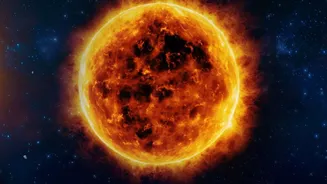
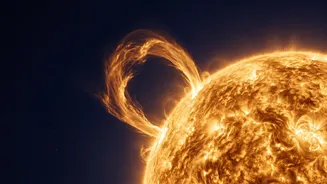
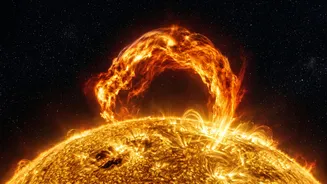
Ninety-three million miles away, the sun is a constant source of life-giving energy. But it also has a violent side. Events like solar flares and coronal mass ejections (CMEs) can blast enormous clouds of charged particles and radiation into space. If
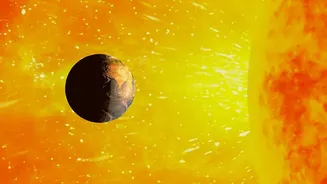
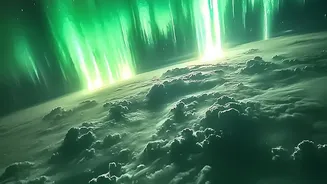
Earth is in the crosshairs, the consequences can be severe. These solar storms can disrupt Earth’s magnetic field, creating what is known as a geomagnetic storm. For a civilisation dependent on technology, this is bad news. These storms can fry satellite electronics, disrupting the GPS, communication, and weather forecasting services we rely on daily. They can also induce powerful currents in power grids on the ground, potentially causing widespread blackouts, as happened in Quebec in 1989. Aviation is also at risk, with radio blackouts and increased radiation affecting transpolar flights.
The Challenge of Cosmic Forecasting
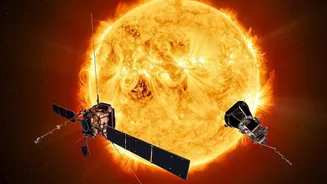
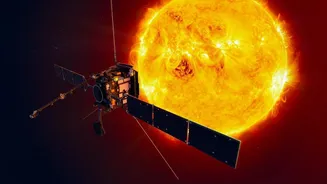
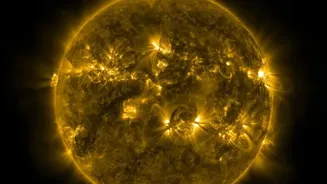
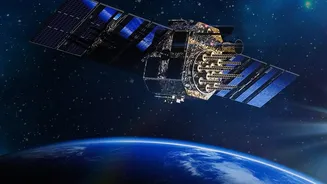
For decades, predicting space weather has been a slow, painstaking process. Scientists have relied on a network of satellites, like NASA's Solar Dynamics Observatory (SDO), to watch the sun for signs of trouble. When a CME is spotted, human experts analyse the images to determine its speed and trajectory. But this method has significant limitations. By the time scientists can confirm a storm is heading our way, the window to prepare is often short. Furthermore, traditional computer models that provide global predictions haven't been particularly timely, while earlier AI models could only produce localised forecasts. It’s like seeing the flash of lightning but having only moments to brace for the thunder, leaving our critical infrastructure exposed.
AI as the Ultimate Weatherman
This is where artificial intelligence is changing the game. Scientists are now using AI, specifically deep learning, to analyse the vast amounts of data collected by solar observatories. These AI models are trained on years of satellite imagery and solar wind measurements, allowing them to recognise subtle patterns and hidden signals that precede a solar eruption, often far faster and more accurately than human experts can. By finding correlations between the solar wind and geomagnetic disturbances on Earth, these systems can learn to predict the impact of a storm before it even arrives. It's a leap from simply observing space weather to actually forecasting its effects with actionable lead time.
From Hours to Minutes
The key advantage of AI is speed. One groundbreaking model, known as DAGGER (Deep Learning Geomagnetic Perturbation), can predict the specific location and intensity of a geomagnetic disturbance anywhere on Earth with about 30 minutes of warning. Developed by an international team including researchers from NASA and the Inter-University Center for Astronomy and Astrophysics in India, DAGGER uses data from several heliophysics missions to produce predictions in less than a second, updating them every minute. Another new AI model, called EarlyDetect, can spot the warning signs of an emerging active region on the sun nearly nine hours before it even becomes visible. Meanwhile, a model from NASA and IBM named Surya, trained on nine years of SDO data, has shown a 16 percent improvement in predicting solar flares and can forecast where a flare might occur up to two hours in advance.
Protecting Our Digital World
This newfound predictive power is not just an academic exercise. A 30-minute warning is enough time for power grid operators to re-route power and protect transformers, preventing blackouts. Satellite operators can put their spacecraft into a protective safe mode or even adjust their orbits to minimise damage from increased atmospheric drag. Airlines can re-route flights away from polar regions to avoid communication blackouts and radiation exposure. Essentially, AI provides the crucial lead time needed to move from a reactive to a proactive stance. These open-source models can be adopted by telecommunications companies and other industries to build their own specific warning systems, creating a global shield against solar storms.